
Click the image above to download a pdf copy of the exhibition essay.
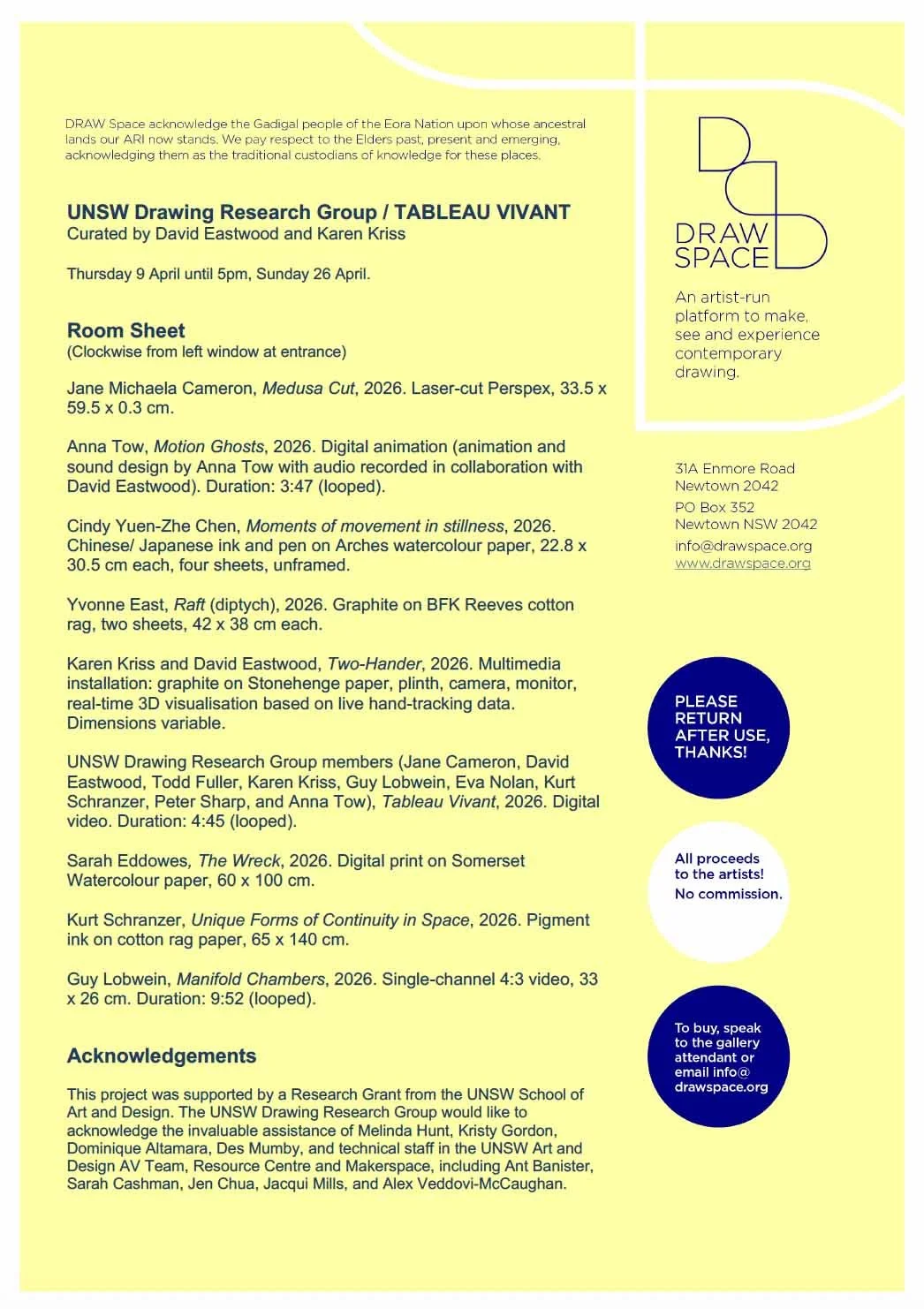
Click the image above to download a pdf copy of the exhibition room sheet.
TABLEAU VIVANT / UNSW Drawing Research Group
In April DRAW Space presented TABLEAU VIVANT / UNSW Drawing Research Group. Open from 11am Thursday 9 April to 5pm Sunday 26 April. A floor talk took place from 3pm on Saturday 11 April, with artists David Eastwood, Karen Kriss, Guy Lobwein, Anna Tow and Cindy Yuen-Zhe Chen.
Tableau Vivant presents the outcomes of collaborative experiments undertaken by members of the UNSW Drawing Research Group (DRG). The project investigates drawing as a live field of peripheral, ambient and embodied phenomena beyond the static page.
Developed through a series of workshops held in UNSW Art & Design's ‘Black Box’ facility, the creative methods adopted range across a variety of mark‑making practices combined with motion‑capture technology, ceiling‑mounted video recording, and 3D scanning. Centred on the concept of the tableau vivant, or “living picture”, the exhibition frames drawing as a dynamic process shaped by bodies moving through space and augmented by digital technologies, with outcomes featuring time-lapse video, animation, real-time interactive 3D graphics, and works on paper.
The UNSW Drawing Research Group brings together artists, designers, and academics working across analogue and digital media. Tableau Vivant presents collaborative experiments that explore drawing as an expanded, embodied practice. The exhibition developed through an evolving process of workshops, working with technology (3D scanning, motion capture, 3D visualisation) alongside handmade drawing processes to give form to movement, data, and embodied experience. Engaging with multi-figure compositions, the exhibition envisions drawing as a living, dynamic form.
– David Eastwood and Karen Kriss
This project was led by Karen Kriss and David Eastwood and supported by a grant from the UNSW School of Art & Design. The DRG comprises permanent academic staff, sessional academics and Higher Degree Research candidates from the UNSW School of Art & Design. The members participating in the exhibition are:
Jane Michaele Cameron
Cindy Yuen‑Zhe Chen
Yvonne East
David Eastwood
Sarah Eddowes
Todd Fuller
Karen Kriss
Guy Lobwein
Eva Nolan
Kurt Schranzer
Peter Sharp
Anna Tow
Tableau Vivant
Essay by David Eastwood (2026)
The exhibition Tableau Vivant explores drawing as an active and time‑based practice operating beyond fixed, graphic outcomes. The works in this exhibition emerge from a series of collaborative drawing workshops that foreground the expressive potential of bodies gathered together in space. Led by Karen Kriss and David Eastwood, members of the UNSW Drawing Research Group (DRG) were invited to participate in the creation of large-scale drawings while being tracked and recorded with digital technologies, including video, motion capture, and 3D scanning. The data collected from the workshops informed the work produced for this exhibition.
The participating artists investigate drawing as a form of motion capture. Expanding on Catherine de Zegher’s description of drawing as a “kinesthetic practice of traction” (de Zegher 2011, 23), the exhibition frames mark making as a durational procedure shaped by spatial relation and trajectories of bodily movement. The works result from varied analogue and digital approaches to convey spatio‑temporal data, deploying immersive technologies and 3D visualisation to engage with ambient and peripheral phenomena captured in the act of drawing, which is conceived here as a live, dynamic medium.
The title Tableau Vivant translates as “living picture” and refers to a theatrical practice in which performers hold still in a group pose to recreate a scene from art, literature or history. With antecedents in antiquity and the medieval period, the tradition was revived as a form of entertainment in the late-18th and early-19th centuries. Described by Johann Wolfgang von Goethe as a hybrid of painting and theatre (Solanki 2016, 245), such live, posed scenes occupy a space between image and performance, where stillness and movement are held in a prolonged state of tension.
The tableau vivant has close affinities with histories of imaging processes that seek to stabilise the body within a carefully composed visual field. From the painter’s studio, where live models hold static poses for extended periods, to the emergence of photography and other technologies, stillness has frequently functioned as a practical requirement for visual representation. The long exposure times of early cameras necessitated the immobilisation of the model, encouraging staged poses closely resembling tableaux vivants (Boucher & Contogouris 2019, 9). A similar principle operates in contemporary 3D‑scanning technologies, which rely on the subject’s sustained stillness to maintain a consistent pose during the capture of spatial data. Across these contexts, technical processes impose bodily stasis as a means of translating the human form into a coherent, visual ideal.
In contrast to the conventional tableau vivant’s prioritisation of stability, this project attends to the unruly conditions of living bodies. Over several months leading up to the exhibition at DRAW Space, DRG members engaged in a series of workshops held in the Black Box, a flexible installation space at UNSW designed to support experimental practices in moving image, sound, performance and installation. Movement was central to the drawing process in these workshops. Digital tracking technologies were employed not to immobilise the subject, but to register the continuous modulation of forms unfolding over time. This approach privileges distortion as a generative condition, foregrounding the instability of the body. In doing so, the workshops deploy drawing as an expanded field in which the human form is neither fixed nor resolved, but emerges through duration, relation and the dynamic interplay between bodies, materials, technologies and space.
The last of the workshops centred around Théodore Géricault’s The Raft of the Medusa (1819), an iconic painting from the French Romantic era depicting shipwreck survivors adrift on the ocean on a makeshift raft. Staged as a precarious convergence of bodies, the painting’s reference in the workshop functioned as an analogy for the fluid and contingent structure of the DRG’s collaborative process, characterised by varying modes and intensities of engagement over time. The nine participants in this particular workshop, Jane Cameron, David Eastwood, Todd Fuller, Karen Kriss, Guy Lobwein, Eva Nolan, Kurt Schranzer, Peter Sharp, and Anna Tow, each adopted the pose of individual figures from the painting to be traced in charcoal on a large sheet of paper where they lay. The composition was re-enacted in three stages to cumulatively reconstruct the dense arrangement of bodies from the painting. Through this process, the illusionistic depth of Géricault’s composition was compressed into a field of low relief, where participants negotiated the tension between the physical space of their bodies and the imaginary space inside the picture plane.
A high-resolution scan of each of the three group poses was made using an Artec Leo wireless 3D scanner operated by Alexander Veddovi-McCaughan, Senior Technical Officer in the UNSW School of Art & Design, who moved through the space scanning the workshop participants’ bodies as the outline drawing was underway. The three digital files were later merged into a single composition (fig. 1), resulting in fusions of different poses and incorporating imperfections caused by slight movements of bodies during the scanning. The irregularities in the scans were retained, conceived not as errors requiring correction but as a means of resisting the normative expectations of proprietary digital capture systems, which privilege seamless accuracy. By embracing the unanticipated results of the group scans, the project foregrounds the presence of living, responsive bodies as an integral component of the creative process.
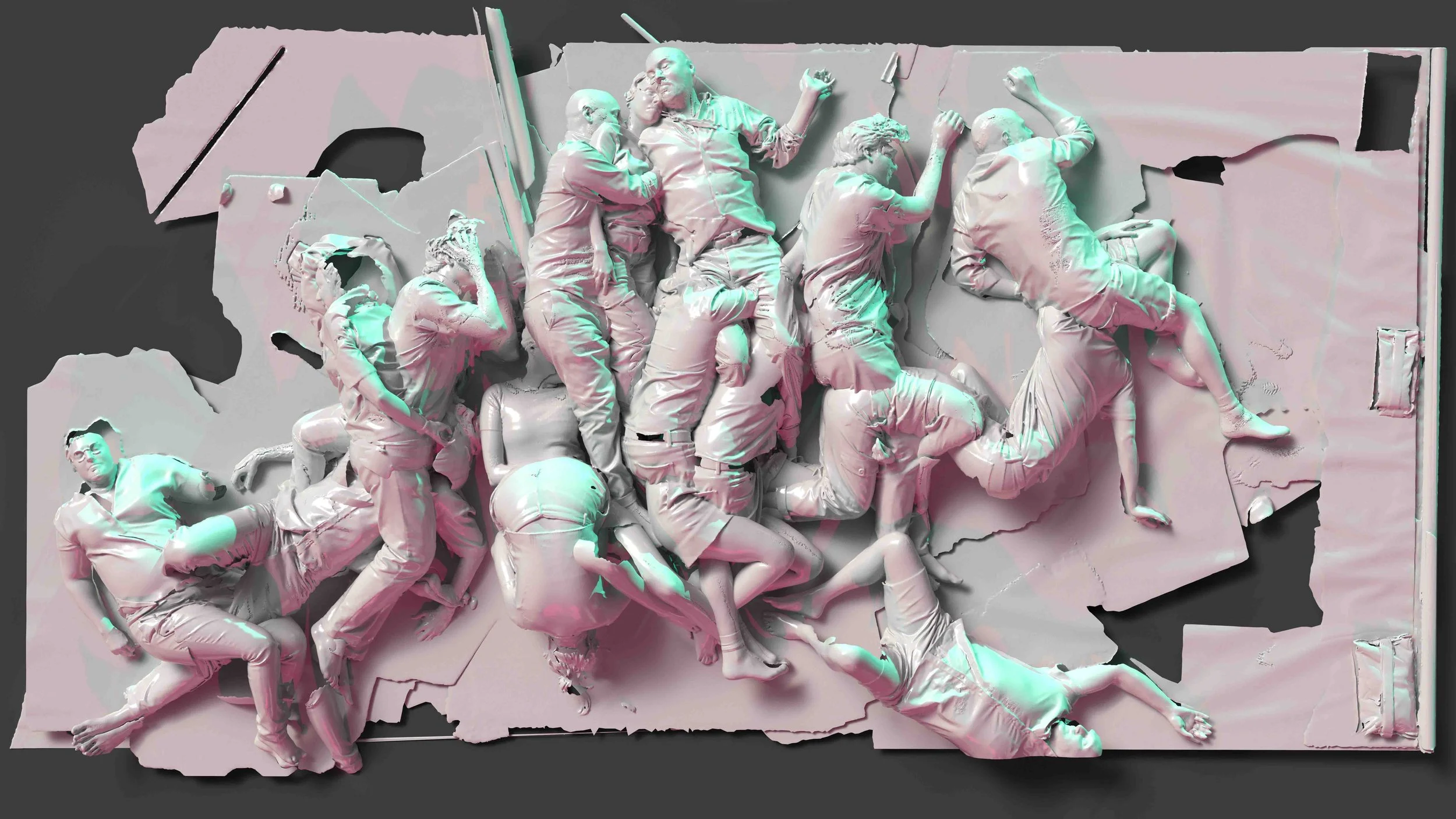
Figure 1: UNSW Drawing Research Group, Tableau Vivant, 2026, digital image rendered from a 3D model.
The 3D scans from the workshop were shared with members of the Drawing Research Group, leading to a selection of works developed for the Tableau Vivant exhibition. Yvonne East, who was unable to attend the workshop in which the scans were generated, worked with the files to produce Raft (diptych) (2026) (fig. 2), featuring two views of the 3D model depicted in graphite on cotton rag paper. One drawing shows a close-up detail in the form of a triple portrait, and another shows the full group of scanned bodies from a distance. In these delicately rendered works, bodies coalesce into a hybrid entity, with individual identities becoming subsumed into a collective mass. The view depicted from afar resembles a pile of prostrate figures from a scene of human devastation and loss. East’s interpretation of the living picture invokes a confronting ambivalence, oscillating between presence and erasure. Her faint and ghostly drawings call to mind the proximity of mortality in Gericault’s original painting, in which lifeless bodies lie among survivors.
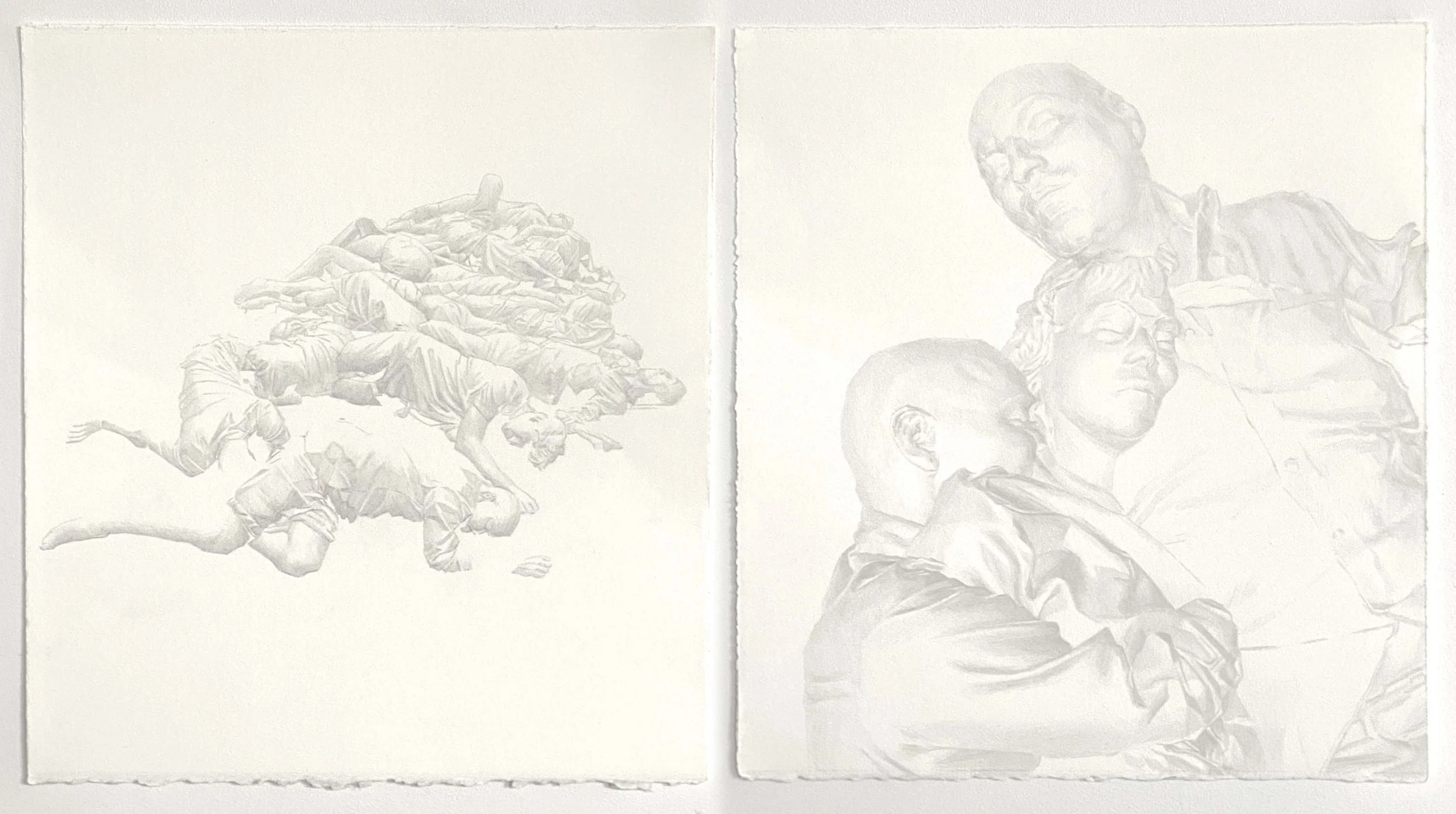
Figure 2: Yvonne East, Raft (diptych), 2026. Graphite on BFK Reeves cotton rag, two sheets, 42 × 38 cm each.
Sarah Eddowes interprets the same scan in her digital print The Wreck (2026) (fig. 3). Employing 3D rendering techniques such as subsurface scattering, Eddowes illuminates the digital model with a pink glow that appears to emanate from within the bodies themselves. Woven into the scene are fragmentary references to Géricault’s original painting, linking the work to its art-historical source. The entangled mass of bodies not only appears vulnerable to the turbulent conditions of the ocean that threaten to overwhelm it, but the intense inner glow implies the presence of a malign force animated from within. The foreboding luminosity of the tumultuous composition suggests a latent and volatile intensity, warning of imminent calamity.
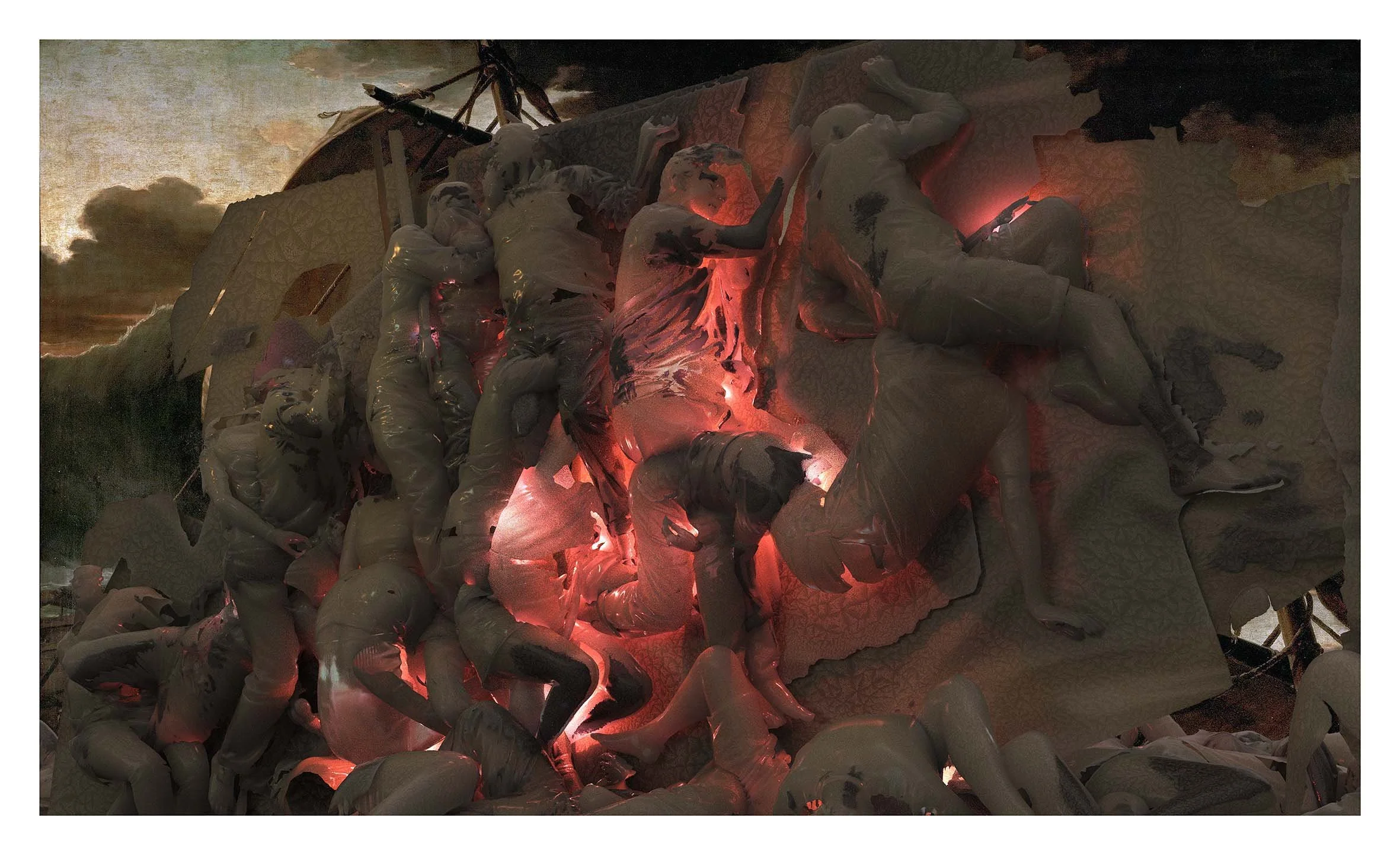
Figure 3: Sarah Eddowes, The Wreck, 2026, digital print on Somerset Watercolour paper, 60 × 100 cm.
Jane Michaele Cameron’s laser‑cut work in clear Perspex, Medusa Cut (2026) (fig. 4), is another creative interpretation based on the 3D scan. Suspended in the gallery’s window space, the work does not function as a self-contained image. Viewed from inside the gallery, its transparency invites observation of the passing traffic in the street. The cutout silhouettes of the scanned figures are echoed by the related works elsewhere in the exhibition, while simultaneously recalling the pedestrians who pass by outside. Cameron expands the concept of the tableau vivant beyond the staged pose, incorporating the unchoreographed parade of passers-by in the urban environment. By drawing the street into the exhibition space, Medusa Cut situates the living picture as an image animated by life in real time.
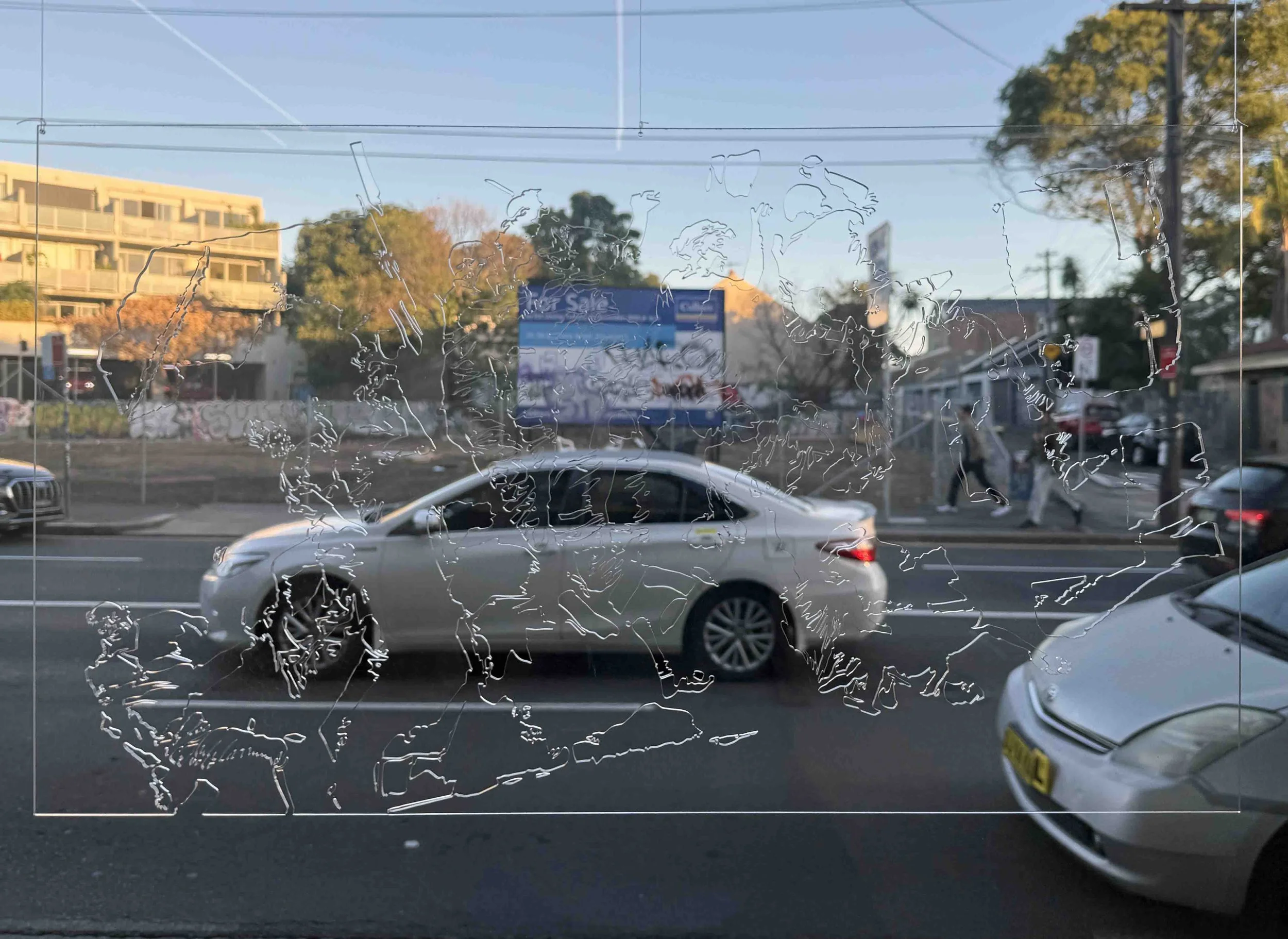
Figure 4: Jane Michaele Cameron, Medusa Cut (installation view), 2026. Laser-cut Perspex, 33.5 × 59.5 × 0.3 cm.
The workshop that generated the above-mentioned 3D scan was recorded via a ceiling‑mounted video camera, enabling the inclusion of a time‑lapse video (fig. 5) in the exhibition. Projected onto the rear wall of the gallery, the video contextualises the related works on display and documents the collaborative workshop process. Notably, none of the large‑scale drawings produced during the Drawing Research Group’s workshops are included in this exhibition. These drawings were understood as by‑products of experimentation, not as finished outcomes, with attention instead focused on the information generated through the capture of the spatio-temporal data of bodies collaborating on creative acts. This approach foregrounds the contingent, processual labour of studio practice as a site of artistic production in its own right.
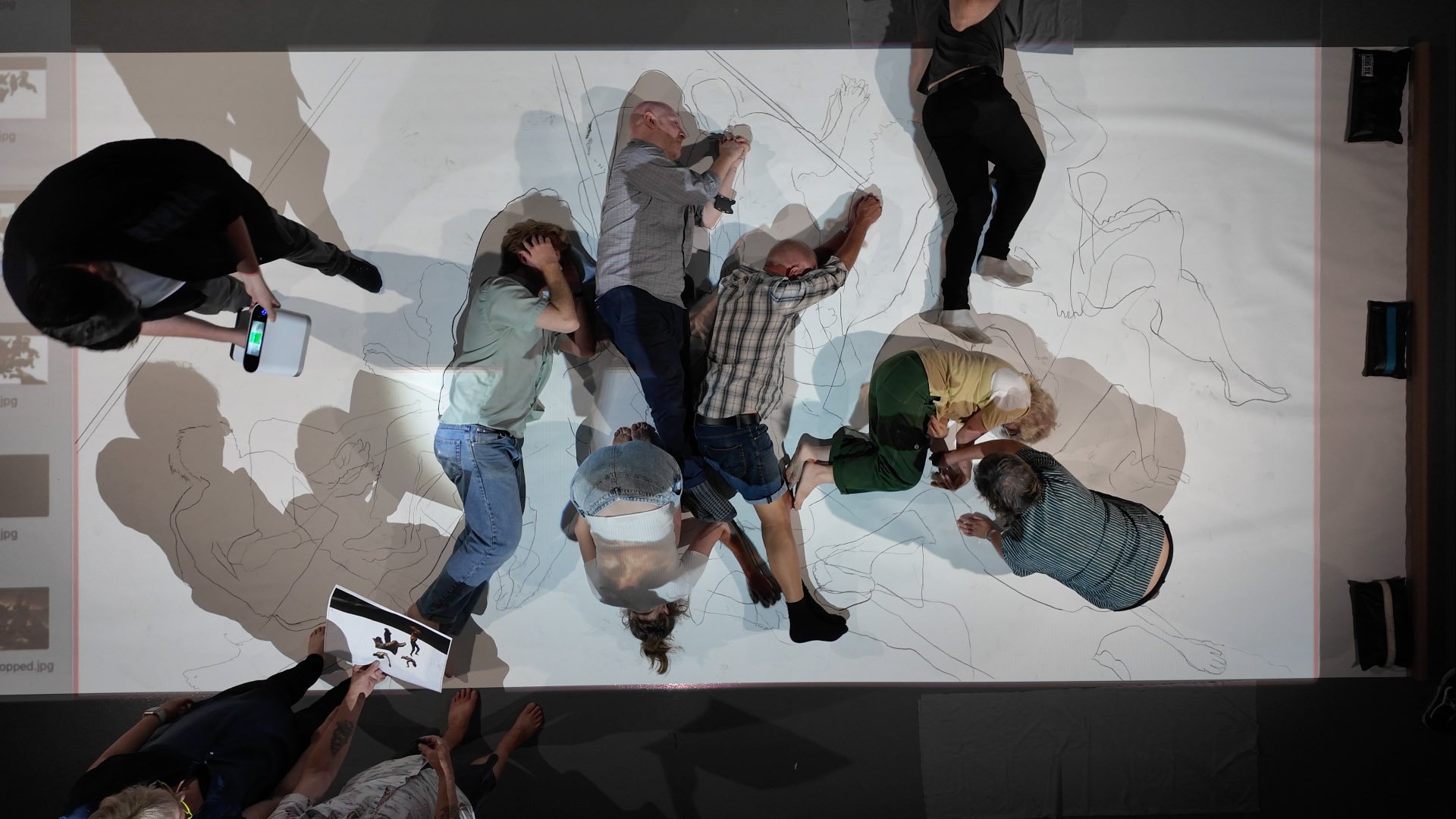
Figure 5: UNSW Drawing Research Group members (Jane Cameron, David Eastwood, Todd Fuller, Karen Kriss, Guy Lobwein, Eva Nolan, Kurt Schranzer, Peter Sharp, and Anna Tow), Tableau Vivant (video still), 2026, digital video. Duration: 4:45 (looped).
In a prior workshop, Drawing Research Group members were tracked with motion‑capture technology while working collectively on large‑scale drawing projects in the Black Box. The data that was generated has been incorporated into some of the exhibited works in various ways. This is most apparent in the animated videos, such as Anna Tow’s Motion Ghosts (2026) (fig. 6). In Tow’s creative interpretation of the motion data, animated polyhedrons follow the trajectories of the tracking markers that were attached to the arms and hands of workshop participants during the execution of a collaborative drawing. The abstract animation converts the data into constellations of mysterious, geometric entities that glide around each other. The trajectories of these cosmic bodies are marked with ephemeral trails of fading particles, accumulating and dispersing in ways that recall the inscription and erasure of drawn marks. In this sense, Tow’s animation does not merely visualise motion capture data but uses it to imaginatively generate a form of extended mark making. The video’s basis in drawing is underscored by the accompanying sound design, created by Tow using audio recordings she produced in collaboration with David Eastwood. Working with the physical properties of drawing, the artists generated a range of sound textures with materials such as pencils, charcoal and paper. The audio component of the work explores drawing’s potential beyond a purely optical mode. Combining sound and animated imagery, the work demonstrates a multisensory understanding of drawing as a durational process.
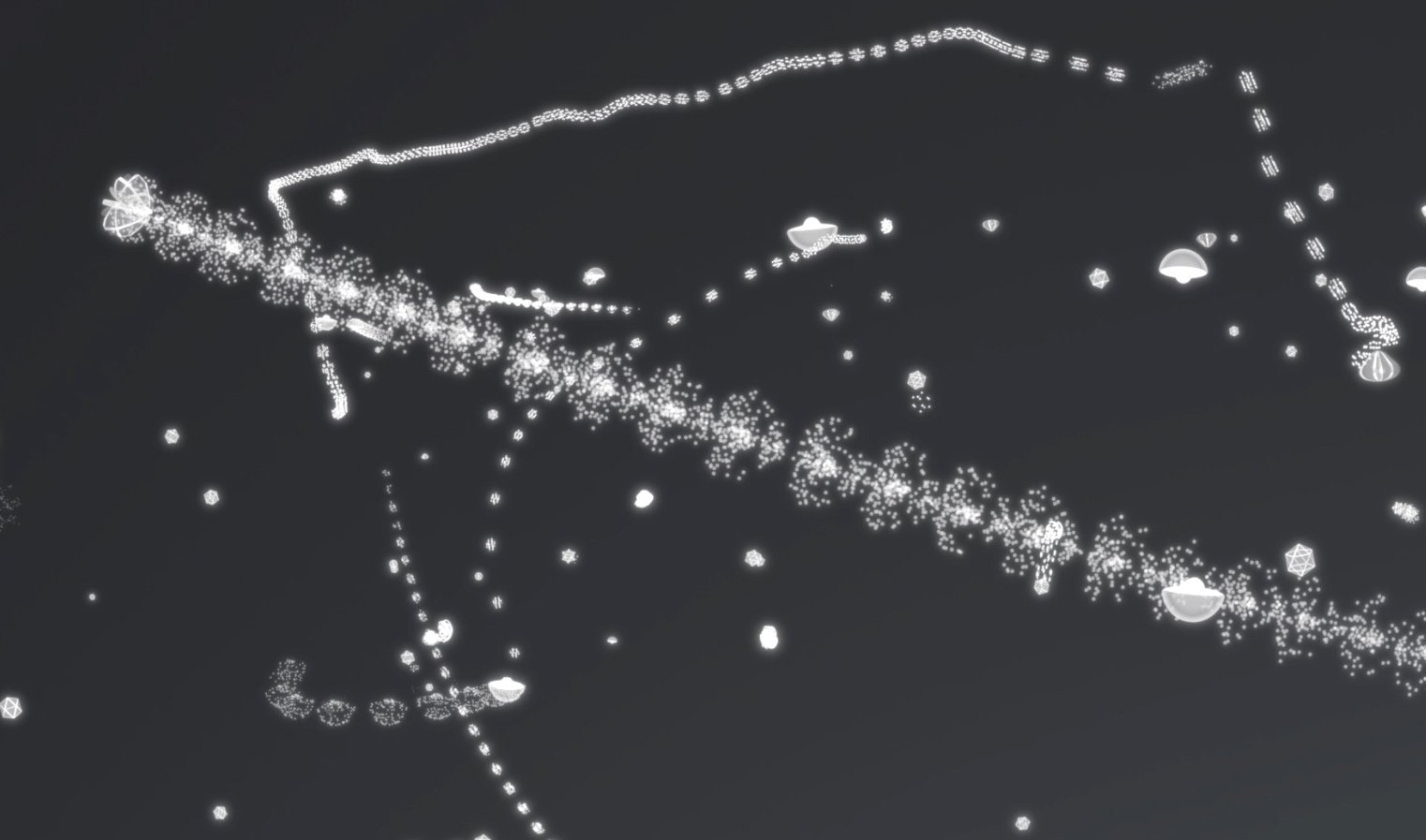
Figure 6: Anna Tow, Motion Ghosts (video still), 2026, digital animation (animation and sound design by Anna Tow with audio recorded in collaboration with David Eastwood). Duration: 3:47 (looped).
In the spirit of collaboration, Tow shared a test visualisation of the motion capture data with fellow DRG member Cindy Yuen-Zhe Chen, who responded to the digital content with a series of four drawings in Chinese and Japanese ink. Titled Moments of movement in stillness (2026) (fig. 7), Chen’s drawings interpret the motion capture recording, incorporating still points represented as cumulative marks concentrated within small, circumscribed areas, and contrasting these with trajectories of motion rendered with swooping brush strokes. Chen’s drawings re-enact the gestures that were tracked in the workshop, re-interpreting them via analogue materials. The resulting calligraphic images are not only deftly crafted drawings, but memories of prior acts of drawing undertaken in the Black Box. In translating data into ink on paper, Chen enacts a recursive process in which human movement is digitally tracked, abstracted and re-materialised, underscoring the exhibition’s broader concern with drawing’s capacity to traverse analogue and digital media, generating reciprocal and interdependent outcomes.
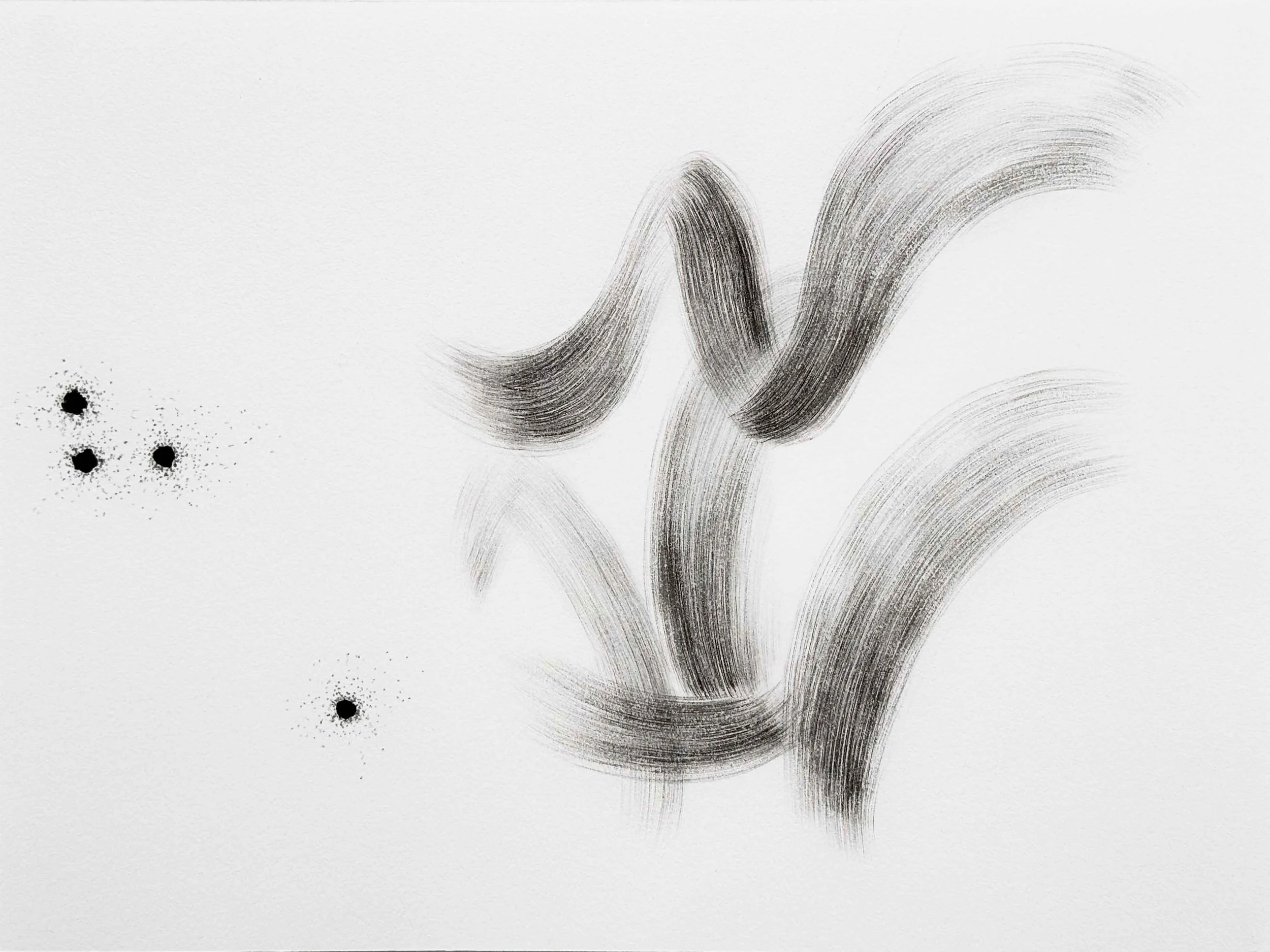
Figure 7: Cindy Chen, Moments of movement in stillness (detail), 2026. Chinese/Japanese ink and pen on Arches watercolour paper, 22.8 × 30.5 cm each, four sheets, unframed.
Another distinctive approach to combining analogue and digital drawing techniques can be seen in Kurt Schranzer’s digital print, Unique Forms of Continuity in Space (2026) (fig. 8). Commencing as an ink drawing with collaged elements, the work is subsequently scanned, digitally manipulated and, when complete, printed on paper. Eschewing hierarchical distinctions between media, Schranzer’s process establishes a reciprocal exchange between handmade and computational procedures that inform and transform one another. The outcome retains the material memory of its analogue origins while bearing the imprint of digital intervention. Schranzer situates his work within a modernist lineage of practices that visualise the complexities of bodies in flux. The title references Umberto Boccioni’s Futurist sculpture, highlighting the work’s concern with dynamism and motion. Incorporated within the image are oblique allusions to the motion capture process. Extending the collaborative logic that underpins the exhibition, the work includes a translation of particle effects derived from a preliminary motion capture data visualisation developed in Unreal Engine by Guy Lobwein.
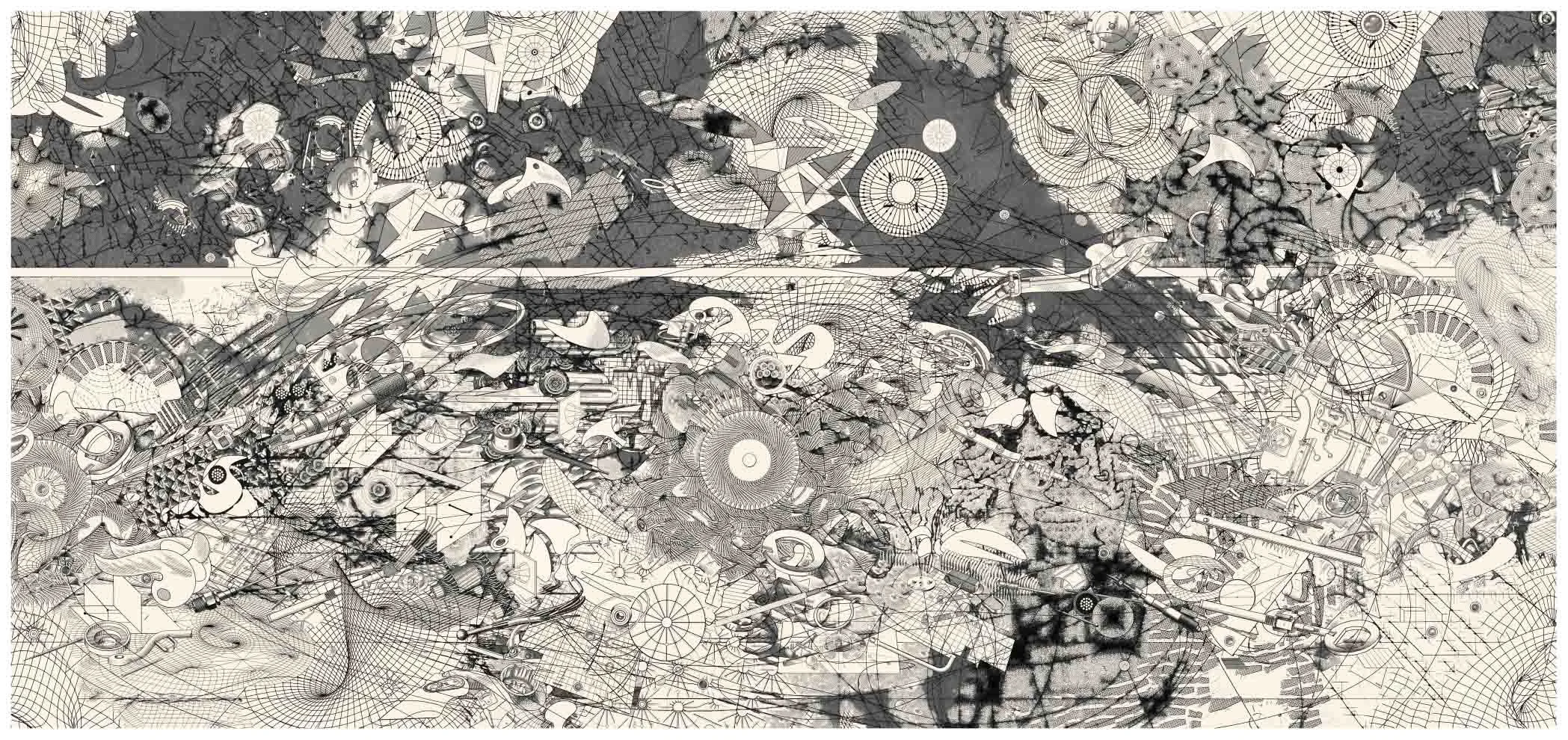
Figure 8: Kurt Schranzer, Unique Forms of Continuity in Space, 2026, pigment ink on cotton rag paper, 65 × 140 cm.
The creative dialogue between Lobwein and Schranzer proved to be a productive influence on Lobwein’s animation, Manifold Chambers (2026) (fig. 9), which adopts geometric structures found in Schranzer’s composition as a point of departure. Both artists share a common interest in modernist visual languages, with El Lissitzky’s Proun series finding resonance in the abstract structures of Lobwein’s animation through its exploration of non-Euclidean spatial systems. Manifold Chambersunfolds through a series of animated vignettes, in which sequences derived from motion capture data generated during the DRG workshops are interspersed with shifting, constructed environments. These speculative spaces are rendered in a graphic pictorial language that lends aesthetic coherence to the work as it moves across multiple spatial registers.
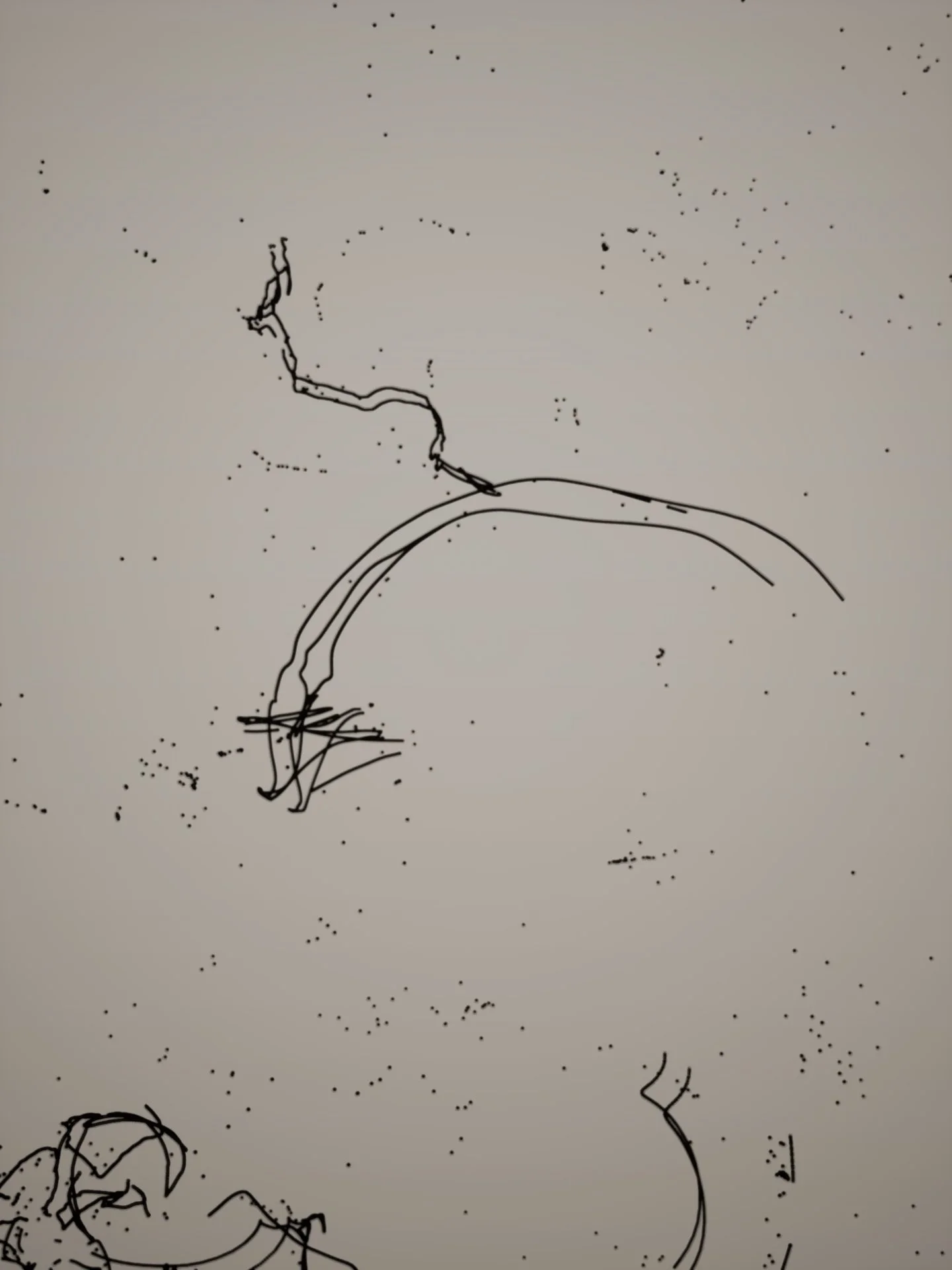
Figure 9: Guy Lobwein, Manifold Chambers (video still), 2026, single-channel 4:3 video, 33 × 26 cm. Duration: 9:52 (looped).
Further evidence of collaborative exchange within the Tableau Vivant exhibition can be seen in Karen Kriss and David Eastwood’s co-authored work Two‑Hander (2026) (fig. 10), in which the artists build on their workshop experiments with motion capture to produce an interactive multimedia installation. One of the aims of this work was to develop a responsive motion‑capture experience that could operate within the DRAW Space exhibition, without the need for a specialised configuration in a controlled setting. Passive optical motion‑capture systems like that installed in the Black Box require extensive calibration processes before use, including the alignment of multiple infra-red cameras, controlled lighting conditions, and the placement and registration of markers on the body. These procedures are time‑intensive and must be carefully adjusted for each participant and spatial arrangement, making them unsuitable for spontaneous engagement in an exhibition. Kriss and Eastwood sought a more accessible mode of capture that enabled gallery visitors to participate intuitively. Using the node-based software TouchDesigner, they have produced an interactive work capable of tracking hand motion in real time without the need for the time-consuming calibration requirements associated with more complex systems.
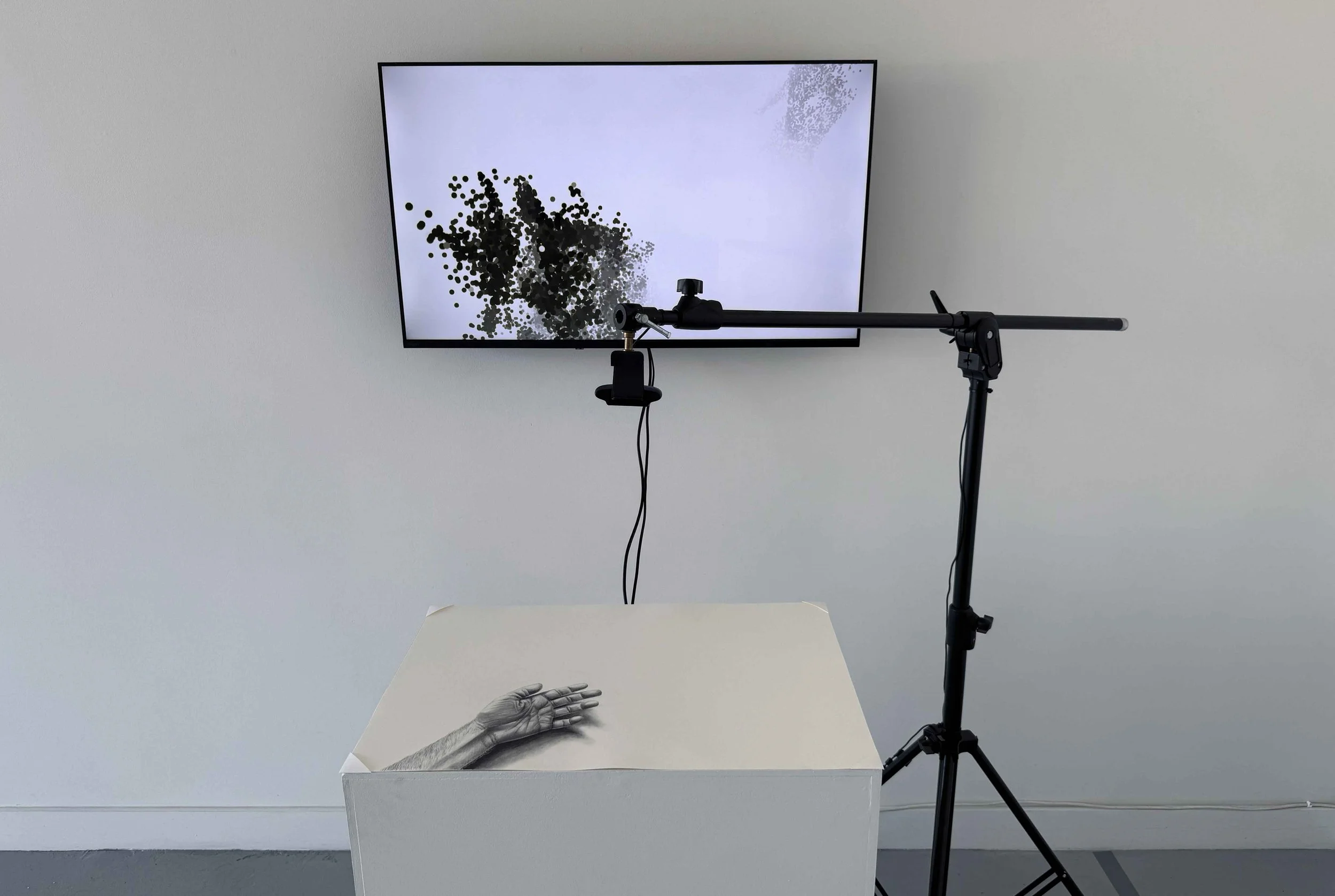
Figure 10: Karen Kriss and David Eastwood, Two-Hander, 2026, multimedia installation: graphite on Stonehenge paper, plinth, camera, monitor, real-time 3D visualisation based on live hand-tracking data. Dimensions variable.
The title, Two‑Hander, not only refers to the literal role of hands in the work, but also the reciprocal nature of the two-person collaboration itself. The work emerges through the interdependence of two distinct skill sets: Eastwood’s proficiency in drawing and Kriss’s expertise in animation and interactive systems, with concepts shaped through experimentation and consultation between the two artists. The work combines analogue drawing techniques with hand‑tracking technology to explore drawing as an exchange between human gesture and machine interpretation. It features a camera directed towards a graphite drawing of a hand on paper placed on top of a plinth. The video feed of the drawing is interpreted by hand-detection software and translated in real time into a swirling mass of animated particles displayed on an adjacent monitor. Viewers are invited to participate by holding their own hands over the drawing, enabling their gestures to influence the movement and behaviour of the particles on screen. The work establishes a dialogue between two modes of representation: manual drawing and interactive visualisation, extending drawing beyond the static page and foregrounding the image as a responsive and continuously unfolding entity.
Although Two‑Hander is the only officially co‑authored work in the exhibition, collaboration operates across the project as a whole. The workshop process functioned as a shared laboratory in which artists gathered to test ideas, exchange skills, and generate drawings, scans, and datasets that exceeded individual ownership. In this context, all participants have influenced and helped to shape the outcomes in the exhibition. In a broad sense, authorship is not a singular, solitary act, but emerges as a distributed and relational process, shaped through negotiation, responsiveness, and mutual interaction. Individual contributions remain distinct, grounded in differing interests and areas of expertise, yet operate within the broader context of collective action and exchange.
The exhibition also foregrounds the productive coexistence of analogue and digital approaches to drawing as an expanded practice. Graphite, paper, ink, scanning technologies, animation, and interactive systems are mobilised without hierarchical distinction, reflecting the varied specialisations and interests of the participating artists. Far from situating the handmade in opposition to machinic processes, this exhibition demonstrates how these modes can interact and influence one another. The concept of the living picture is not tied to any individual approach or specific medium. The works inTableau Vivantdemonstrate that collaboration does not dissolve individual agency, but can reorient it, positioning authorship as something that emerges through dialogue, mediation, and shared effort.
References
Boucher, Mélanie and Ersy Contogouris. 2019. “Introduction: Stay Still: Past, Present, and Practice of the Tableau Vivant / Introduction: Stay Still: histoire, actualité et pratique du tableau vivant.” RACAR: Revue d'art canadienne / Canadian Art Review, 44 (2)” 7–18. https://doi.org/10.7202/1068314ar
de Zegher, Catherine. 2011. On Line: Drawing Through the Twentieth Century. New York: Museum of Modern Art.
Solanki, Tanvi. 2016. “A Book of Living Paintings: Tableaux Vivants in Goethe’sDie Wahlverwandtschaften(1809).” InGoethe Yearbook 23, edited by Adrian Daub and Elisabeth Krimmer, 245-70. Boydell & Brewer.
Credits and Acknowledgements: Tableau Vivant was curated by David Eastwood and Karen Kriss and presented at DRAW Space, Newtown (Sydney), from 9–26 April 2026. The exhibition formed part of a UNSW Drawing Research Group project, supported by a Research Grant from the UNSW School of Art & Design. The participating artists were Jane Michaele Cameron, Cindy Yuen Zhe-Chen, Yvonne East, David Eastwood, Sarah Eddowes, Todd Fuller, Karen Kriss, Guy Lobwein, Eva Nolan, Kurt Schranzer, Peter Sharp, and Anna Tow. The curators gratefully acknowledge the invaluable assistance and support from Melinda Hunt, Kristy Gordon, Dominique Altamara, and Des Mumby, as well as the technical staff of the UNSW Art & Design AV Team, Resource Centre, and Makerspace, including Ant Banister, Sarah Cashman, Jen Chua, Jacqui Mills, and Alex Veddovi-McCaughan.