
Click here to download a pdf copy of the IMMERSION exhibition essay.
Group Show / IMMERSION
DRAW Space presents Group Show / IMMERSION. Opening 6-8pm Thursday 13 November until 5pm Sunday 7 December, Kristy Gordon (curator) and the DRAW Space board invite you to join the artists to celebrate.
IMMERSION dives deep into drawing processes where excessive, cumulative and durational mark-making takes the artists into a state of utter immersion in their process, in the terrains of their drawings and in their own subjective worlds. Across diverse materialities and scales, these drawings present as dense sensorial webs of these artists’ living, breathing time.
Featured artists: Belinda Yee, Bridget Hillebrand, Claire Tozer, Damian Moss, Isobel Rayson, Jade Gillis, Kristy Gordon, Matti, Natasha Dubler and Sally Blake.
Curatorial note:
“Amidst contemporary speed culture that perpetuates an accelerating pace in everyday life, art can offer an alternative pace; another mode of thinking, doing, and being. IMMERSION invites an experience of slowness, through the rhythms of repetition. The artists engage with repetition in many forms and for various reasons: to soothe an anxious mind; for self-control; to pursue aesthetic experience; to closely examine place; and to deeply connect with the natural world. These can be important practices for remaking our ways of being in the world.”
Kristy Gordon
Click here to download a pdf copy of the IMMERSION exhibition roomsheet.
Slow Listening Experience at DRAW Space, 7.30pm Thursday 27 November
Artist Natasha Dubler and curator Kristy Gordon host this deeply immersive, speculative sound experience in the gallery after hours, where Natasha's Between the Turns of Tide will be performed exclusively in its complete eight-channel composition.
This dynamic sonic work will ebb and flow through eight speakers surrounding the audience, amplified to fill the ambient space of the gallery, and resonate between the drawings on the walls and our bodies in the space. It promises to deliver a unique experience of contemporary art, of watery atmosphere, and of the durational space between repetitions.
In IMMERSION, the ten artists, across medium and materiality, work with methods of repetition to enter a state of utter immersion; in their process, in the terrains of their work, and in their own subjective worlds.
Following the slow listening experience, please linger to join curator and artist in conversation about resonant aspects of sound recording and sound art, deep listening with water, and slow aesthetics.
Exhibited Drawings




About the drawings
Belinda Yee
Marking Time With You (Silver) (2025)
When mum died, I struggled to find the space and quiet time to digest what had happened. I started a drawing with a simple task - drawing cells across a page - to give myself the time and headspace I needed. I worked with headphones on, listening to music from my childhood and thinking about the moments we shared. The paper became a live space of engagement, a physical place to connect with her, a stage, a threshold through time. The paper holds the trace of that shared time, across those hours, days and now months. A seismograph of sorts, the small marks and clusters capture the flow of feelings. Now years on, I sometimes return to this process because it connects me to mum in a grounded, physical way.
The process of making this work involves covering the paper with another sheet. The top sheet has a small, two-inch hole torn in it, through which I can see the drawing below. This process helps me maintain focus on the present and it prevents the habit of thinking ahead about composition. These physical constraints are material reminders that there is only this – the pen as it moves across the paper.
Bridget Hillebrand
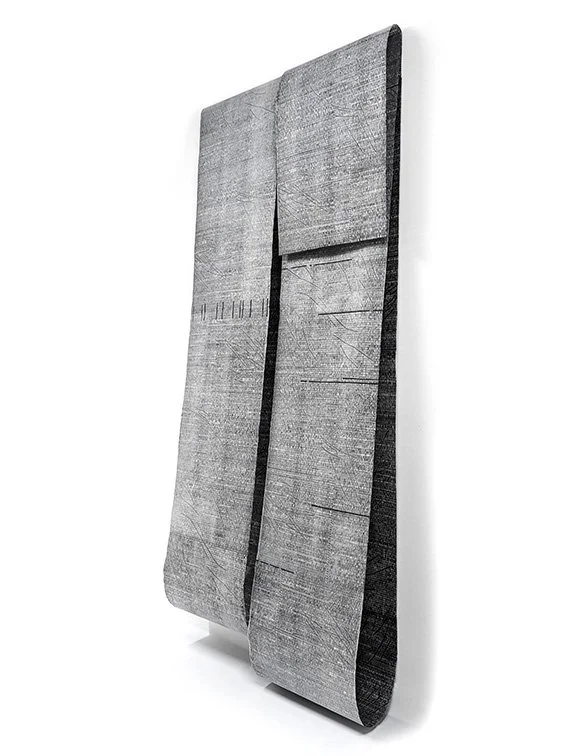
The Deep (2023)
The Deep is part of an ongoing series of work informed by the rapidly shifting ecology of our oceans and river systems. The undulating dimensional properties of the printed washi paper reference a broad ocean swell. Through reiterative actions of drawing, printing and folding, the underside is brought to the fore. Just as the dynamics of the ocean reveal spaces beyond its surface contours, The Deep exposes openings and hidden surfaces that engage the moving viewer.
Shift III (2024)
Printing on engineering felt, I experiment with dimensional properties through the act of folding, layering and stitching. The interplay of repetitive printed marks suggests refraction of light on water, cradled, protected and held.
Claire Tozer
Bundanoon Cave (2019)
This artwork was motivated by the ‘Glow Worm Glen’ cave in Bundanoon (just south of Moss Vale). I started drawing a series of lines to show the forms of a cave wall. I then continued building up tonal marks, working up layers to portray ancient wear on a rocks surface.
It’s observing each stroke of the pen, pencil, pastel; changing directions as I go along. Imagining the marks of water which had dripped down the rock, the stains, old plant life that once grew attached to the surface with crevices, shadows and light.
Damian Moss
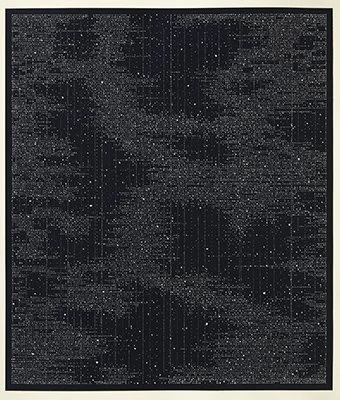
Celestial Cartography No 15, No 20 (2020, 2023)
My drawing practice reflects an interest in mark making and the mechanics of repetition. All compositions in the ‘Celestial Cartography’ series start with a grid, a system which provides pictorial structure while allowing for endless variation.
The process is slow and instinctual. One mark is made, and then another and another, until the final composition resembles a complex music score, a map of the sky or traces of data.
Thousands of marks are made using a pin or etching scribe to lift the inked surface of the paper, each tear revealing the white of the paper. Each mark is placed on the intersection of a horizontal and vertical line. No two marks are the same.
Central to these drawings are a series of juxtapositions: the mechanical and the hand-made, the analogue and digital, the macro and micro, precision and chaos.
Isobel Rayson
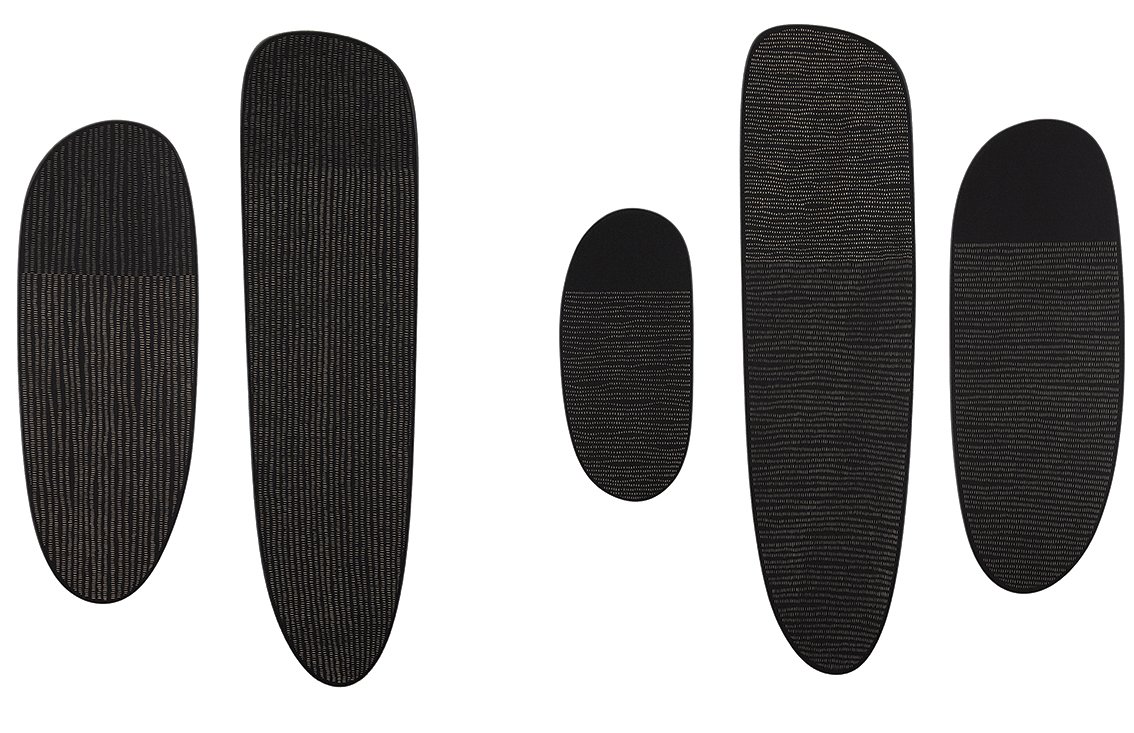
What Lingers I, II, III, IV, V (2025)
The act of making is integral to my artistic practice. Each body of work is guided by process-based methodologies and shaped by material experimentation. I approach my work methodically, engaging in repetitive and often laborious processes. This immersive practice cultivates a welcome sense of distance from the complexities of contemporary existence, providing moments of solace and space for contemplation.
Wall-based relief wood carvings form the foundation of my multidisciplinary practice. I'm drawn to the reductive process of carving, its immediate and permanent mark, and the immersive and contemplative state that emerges from this approach.
Throughout my work, I explore our fragile and impermanent nature, as well as the instinctive need to seek order and structure, often expressed through repetitive processes that mark the passage of time. These themes regularly intersect with ideas of protection and the physical and emotional boundaries we construct in response.
Lived experience and the natural environment serve as enduring sources of quiet yet essential inspiration within my practice. Observations of formal elements in the landscape, such as form, pattern, and texture, alongside moments of personal reflection, inform initial concepts and the development of new work.
Jade Gillis
bedside happenings (2025)
The spaces I inhabit – the familiar – remain the greatest inspiration for my work. The little unassuming corners of the bedroom, the kitchen, the living room; the sweet poetics of the everyday.
Each drawing of mine is a revisiting of a photograph, of a quiet moment suspended in time. Moments of warmth, and of quaintness. At the heart of my practice is this sense of revisiting. Revisiting, reimagining, replaying a fleeting moment over and over, and attempting to eternalize it, through mark making.
The process of stippling, for me, floats somewhere between meticulous labour, and a sort of contemplative, meditative process. Repetition has a way of slowing down time and seemingly reveals to the eye intricacies once overlooked. The depths of a shadow, the veins of a leaf, the heat seeping from a sunbathed window pane.
Yet such laborious revisitation has a way of distorting memory. A once clear moment in time becomes instead scattered matter, a fuzzy recollection. My recurring windows fragment scenes, and so too do my markings which simultaneously dissolve and reconstruct objects, scenes, moments. This tussle between permanence and impermanence – alive at my bedside, draped across the dining room floor, the sofa – continues to be a constant source of curiosity for my practice.
Kristy Gordon
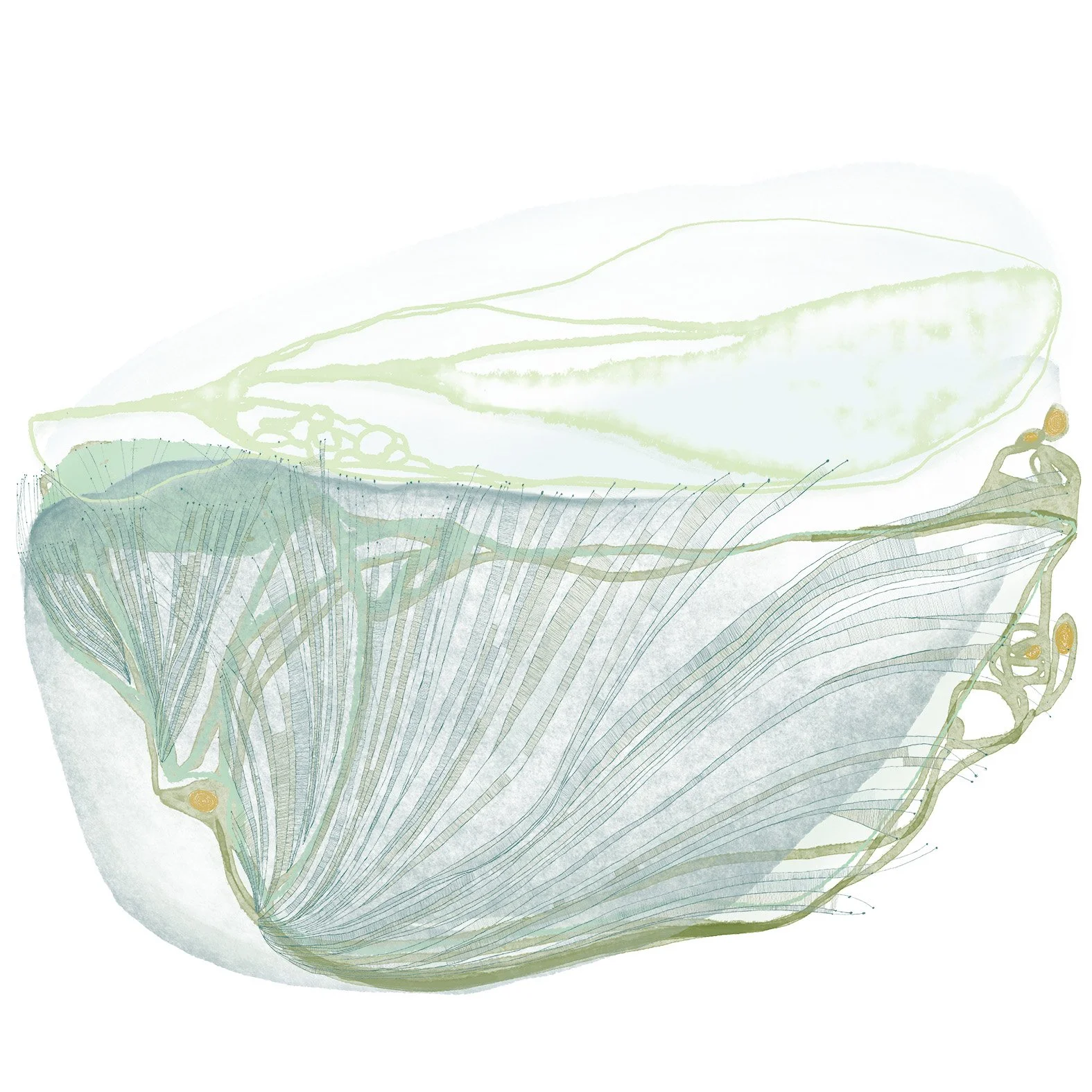
Water Drawings (2024-2025)
My drawings hold experience like my hands hold water. Traces of feeling left where the water was.
Drawing water is my slow reverie, a way of remembering and reimagining my time spent below the surface. Fleeting observations and fragments of sensory memories first experienced in the space of a breath and a dive are laid down as layers of colour, light and mark. The arc of a dive, the shape of a wave, filtered sunlight, kelp dancing over seafloor. Fast sweeps of gestural line and fields of colour become bodies of water, producing atmospheres that cast a watery mood over my drawing state. And there I dwell for prolonged hours, working on fine, detailed lines deep within the terrain of the drawing. Repetition in my process leads me to think more deeply about, attend to, and know more intimately, the feeling of water and of time itself.
Matti
One Million Marks of Anxiety (16/10/2023-27/03/2024)
I used tally marks to count and record one million moments of anxiety. Doing so for a one-hour, self-directed art therapy session every working day for five months, allowed me to immerse myself in the creative zone and ease my emotional state, as my brain was so preoccupied by the marking and counting that it didn’t have the capacity to generate feelings of anxiety, ruminate on the causes, or catastrophise about the outcomes.
When anxiety attacks, disordered sensations come at me from all sides in ways I couldn't have imagined before the triggering event. Hence, four layers of coloured ink (green, red, blue, and black) align with each side of the paper to represent the incessant spikes of terror that underpin the generalised anxiety I had been living with for over a decade, as well as then-undiagnosed PTSD.
The act of drawing externalised the alarm I felt and smoothed my emotional landscape. It is also likely that switching back and forth between my drawing hand and my counting hand accidentally recreated the bilateral stimulation that characterizes a PTSD treatment called EMDR.
Natasha Dubler
Between the Turns of Tide (2025)
Where the tides draw in at the edge of the sea, you lose the shape of things.
Standing on the shore of the River Severn in southwest UK, the tessellated mudflats stretch some ninety metres to meet the water’s edge. My feet slowly sink into the miry ground below as I watch the water steadily advance, folding over itself and erasing the tessellations on the way into shore.
To remain here long enough is to sense that within the repetition of the tides lies insistent variation. There is no boundary here, only gradients, delays, and overlaps.
In the sound installation work Between the Turns of Tide, field recordings made along the 350-kilometre length of the River Severn are modulated by predictive tidal data for the year 2035. Both speculative and grounded, the piece reflects on the inevitability of tidal motion and on our shifting relationship with what is forecast, expected, or yet to come.
Cast in three sections, the work moves from the deep propulsion of underwater currents, through the resonances of beached ships at Purton, and into the wholly unforeseeable, catastrophic, and uncharted.
What is it to be held within the intertidal?
Not as a moment. Not as a place.
But as a duration,
drawn out, returning, never still.
Sally Blake
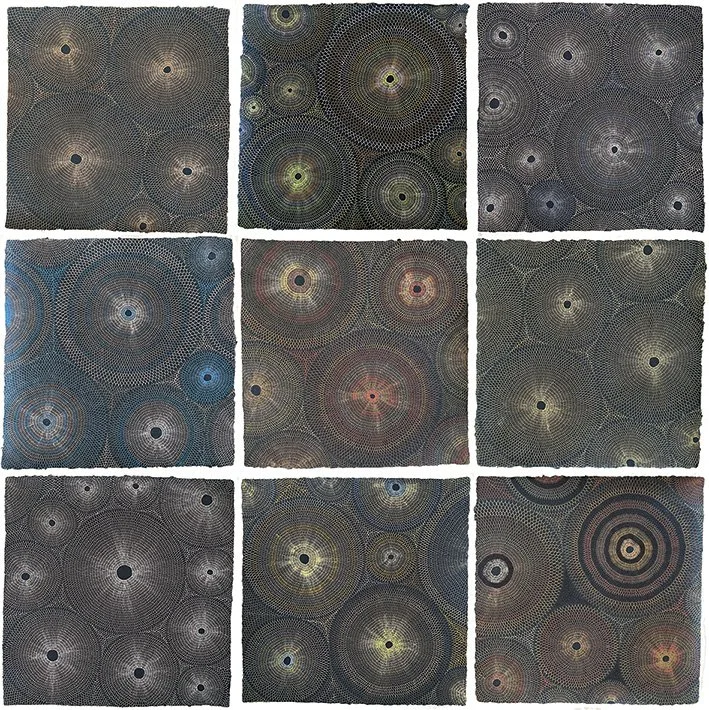
Geyser series (2025), Wellspring series (2025)
Earlier this year I spent 11 days in Iceland and was captivated by its wild landscape shaped by both volcanic fire and glacial ice. The thermal pools and geysers became my inspiration for two series of artworks.
In the Geyser series, my process begins at the outer edge of each circle, using repeated pen marks to gradually work inwards. As each drawing progresses, the image appears to fold and gather upon itself, evoking a sense of movement. The works are drawn in ochre and sulphur hues, echoing the colours of Icelandic geysers, while the silvery tones reference the deeper, churning pools of water.
The Wellspring series exists in the expanded drawing field and are made of woven and wrapped copper wire and beads made from semi-precious stones, Czech glass and Baltic amber. I have lived in Europe for the past 18 months and the ornateness and gilding of European architecture has encouraged me to include these beads in my wire drawings.
Both series are grounded in repetitive mark making and gesture, fundamental processes in my practice. Through these methods, I explore the intricate relationships between humans and the natural world. My research has drawn on paediatrician Donald Winnicott’s theory of potential space—a state of mind that allows individuals to negotiate inner and outer realities with openness and playfulness.
Art historian Claire Pajaczkowska articulates the impact of repetitive making in the context of knitting: “the rhythmic repetition of the simple actions absorbs the free, floating anxiety and allows the knitter’s mind to roam freely across the landscape of thought. Pajaczkowska’s observations forge a connection between repetitive drawing and the achievement of a mental state in which thoughts can ‘roam freely’.1 This creates a space where the boundaries between inner and outer worlds, and between self and nature, become more permeable, and distinctions between them less certain. I understand this state of mind as potential space—a realm where thoughts and feelings move spontaneously, unimpeded by the demands of everyday life.
Exhibition Essay IMMERSION
By Kristy Gordon, artist and exhibition curator
Repetition is inherent in the process of drawing. As the artist directs it, the tool meets the surface, marks the surface, then lifts and returns again in methodical or erratic continuity. The relational position, form and quantity of marks and spaces between produces the drawing: a composition; an object; a communicant of action and experience from which we might be affected, or derive meaning. It is from this first position of drawing, to the emergence of the drawing, where the artist’s intention shifts, broadens, expands, from artistic act into record through method, multiplicity, composition and materiality. Immersion explores exactly this inflection point. In the gallery, we face the drawings. However each foregrounds the processual conditions of drawing. The mark is made consistently and repeatedly, with an intention to stay with the gesture, the process, the mood of a mark. These ten artists featured in Immersion focus presently and extendedly on the active space of drawing and the rhythm of mark, pause, mark, pause, mark pause, mark. Excessive, cumulative, durational and sometimes even obsessive repetitive mark-making takes these artists into a state of utter immersion in their process, in the terrains of their drawing and in their own subjective worlds. Through repetition, these artists sink deep into time.
Repetition can open a resonant space of being. Staying for longer with the same gesture, mark, and area of the drawing’s surface, develops a rhythm in which thinking comes into step with the tempo of the mark-making and of the artist’s own breath. The aesthetic purpose of this kind of drawing practice merges with somatic and temporal experience. As such, the drawings emerge as dense sensorial webs of the artists’ living, breathing time.
Damian Moss employs the term ‘mechanics of repetition’ to describe his quiet and meticulous process. There are two parts to making these works; the first takes only minutes, applying the ink to 100 per cent cotton rag, the second takes months, making thousands of excavations into the surface of the paper. Damian situates these works somewhere between drawings and textiles, navigating as if between warp and weft, and working with the body of the paper, not just the surface. His practice is based on the grid, which he views as ‘a beautiful system of spatial organization, a meditative space, full of endless possibilities’. A pin is used to tear back small pieces of the inked surface at the intersection of vertical and horizontal axes, which are located using a system of rulers mounted on his studio wall. Working within the boundaries of this self-imposed grid, Damian finds freedom to make each mark in a way that he describes as ‘slow and instinctual’, each unique and permanent. Once the paper is torn the mark cannot be erased, it's one step closer to the finished drawing. The aesthetic play within these drawings juxtaposes the mechanical and handmade, digital and analogue, macro and micro, and precision and chaos. When complete, the constellations of marks can be read as cartography of the night sky or a complex music score.
Belinda Yee seeks another delicate balance between control and freedom in her quiet works. Where Damian’s marks end with the tear of the paper surface, Belinda’s field of vision is framed by a tear in a sheet of paper, a two-inch aperture that reveals a fraction of the drawing surface beneath. In this miniature field of view, she travels the fine silverpoint over its ground to produce tiny, abstract whispers. A ‘cell’ is drawn, then another beside it, and so on until the aperture is filled and the overlay must be moved to reveal a new field in which the drawing can grow. Belinda developed this entirely private process of drawing as a mindful practice, to focus her mind on mood, thought and memory as she grieved the loss of her mother. Years later, the practice remains a solitary space of peace, memory and, through them, a feeling of connection.
Repetitive mark-making is a form of art therapy and amelioration for Matti. His highly intentional repetitive practice creates a space where he is unperturbed by the world around him or his inner terrors. For one hour every day, he occupies an empty table in the student commons of UNSW Art and Design, where he formerly studied and worked. He unrolls his large Fabriano paper roll and falls into a rhythm of tally-marks. Methodically he draws ten tallies with his right hand, then presses a mechanical counter with his left, activating both sides of his brain at regular intervals. The simplified, durational and counted mark-making focuses his attention on the combined tasks of drawing and counting, and the aesthetics of the mark, to the exclusion of anxiety-triggering thoughts. Matti draws parallels between this practice and the bilateral stimulation he has experienced during EMDR treatment for his diagnosed generalised anxiety and PTSD. The results of his routine are large tapestries of marked and counted time.
Isobel Rayson’s repetitive carving practice offers a sense of distance from the complexities of everyday existence in another form. Isobel turns to the physical labour of carving to quiet her mind, immersing herself in the rhythm of the work. She seeks order and structure through repetition, describing the work as marking the passage of time, and sharing how this offers her solace in its unique effect of ‘making’ time for reflection and contemplation. Isobel’s skilful inscriptions into her meticulously sanded and painted wood surface present a balanced combination of negative and positive, labour and rest. Her delicate handwork challenges expectations of the force carving might require, the marks appearing light as a feather despite its hard materiality. This work is appropriate to concepts of frailty, protection and emotional balance reoccurring throughout her practice.
Like Isobel, balance is a central concern within Sally Blake’s repetitive mark-making practice, where drawing is a methodology for exploring connection between her inner world of ideas and feelings, and the natural world she inhabits[1]. This work follows psychologist Donald Winnicott’s theory of potential space[2], where her creative practice of drawing and weaving provides access to an intermediate space between self and the external natural world, where she can deeply contemplate notions of connection, relationality, care and wellbeing. The busy play of her hands prevalent in methods of repetitive gesture prolongs this reverie, and facilitates a mindful roaming through the terrains of the artist’s mind[3], terrains that reimagine and reconnect Sally with places that have affected her in her lived experience. Her current work draws from the dramatic Icelandic Geysers that have moved her during recent visits since relocating to Europe.
Claire Tozer’s drawings pay homage to the extraordinary details and textures of the natural world. Via extensive, detailed mark-making, which she builds up in many layers over time, Claire re-explores elemental nature so that the textures of grasses, rocks or waterways are intensified, reconstructed, and reimagined by her exquisite renderings of pen, watercolour, ink and pastel. Each drawing of Claire’s is a single offering of the artist’s time and attention. She attends to only one drawing at a time, working over weeks and months to re-envisage the microscopic details of a rockface, the colours and layers of sandstone and other small evidences of the slow workings of geological time.
A fundamentally slow, reflective and ecologically-centered practice emerges from Bridget Hillebrand’s deep immersion and embodied engagement with the natural world, retracing corporeal experience through the working of hands and materials. Bridget is a passionate rock climber[4] and more recently, wild swimmer. She inscribes line and mark into lino repetitively, excessively, laboriously, fingers tracing surfaces as a climber might, touching, seeking, negotiating connections between body and surface. She expresses what the body learns in elemental nature; sensory, temporal and atmospheric knowledges that come with time, extended experience and embodied connection. The prints that emerge from this practice become terrains unto themselves. Beyond planar, they are folded, layered, cut, into forms that invite visual navigation and exploration. Monumental and yet infinitely delicate, they make tangible the sensory and temporal aspects of the explorer’s - and the artist’s - experience.
Presenting another experiential and watery practice, Natasha Dubler emphasises the sonic repetitions of water. Her sound installation is not interested in a tangible mark, but entirely what happens in the time and space between marks - the geographical and temporal marks of high and low tide. The work thus exists in the duration of the intertidal. Her work explores the oceanographic phenomenon of tidal resonance, where in certain locations, the time it takes for the tide to move in and out of a bay matches the natural rhythm of the tides themselves. On the vast intertidal mudflats of the UK’s River Severn, Natasha lingered between the high and low tide-lines, engaged in deep listening and recording sounds of water: ebb and flow, spiralling into mud, circling shipping debris, intermingling with wind and rain. The work unfolds via the manipulation of site-based field recordings using data which predicts the tidal patterns of the River Severn in the year 2035. Between the Turns of Tide is a speculative tidal experience, and it has a powerful somatic affect. Deeply listening, we can feel in our bones the drama and vibrance of time, place and tidal movement. The ambient work in three channels fills DRAW Space throughout the exhibition, producing new resonances with the visual repetitions of the other drawings. This will be expanded on the evening of 27 November, when the artist presents the complete eight-channel composition for a special slow listening experience (register via the button above)
Jade Gillis lingers slowly and attentively for her arrestingly quiet drawings, which raise notable reference to slow theory in their concept, methodology and outcome. Her intimate drawings have a poignant aura of calm interiority, reflecting the essence of a time in the day before activity stirs, when mind remains calm, soft, quietly observing the small wonders of home and daily experience. Fine stippled pen-marks dot the white space of each A4 page, patiently and ever so gradually bringing into form the otherwise ephemeral beauty of light and its shadows playing through her bedroom window. Jade’s practice celebrates the pleasure in — and necessity of — rest, and acknowledges the temporal affects of repetitive mark-making as an extension of restfulness, as well as an opportunity for amplified attention, and expanded feeling. The drawings ache with yearning for slowness in contrast to haste built into our task-driven lives, and encouraging us to value restful time, our own familiar spaces, and contemplation.
My own creative practice and academic research centres on slow aesthetics. Where Jade finds rest and quiet observation to be a salve to the speed of everyday experience, I take to the water to connect body and mind, and from this I draw, as a means of holding onto this state of being. I think of drawings as watery containers that hold, sustain and perpetuate slow aesthetic experiences in new ways. Repetitive mark-making plays an important role in my process, making time and space to still myself, reflect, contemplate and linger in the terrains of watery experience, memory and imagination.
There lies an inherent correlation between repetition and notions of order, calm, mindfulness and care in this collection of works and in the intentions and practices of each artist. Across medium and materiality, all rely on some kind of metronomic encounter with the body, the mind or the external world. The artists expose the affective qualities of repetition in temporal, somatic and emotional registers, reinforcing how it can propagate unique space-times where body and mind calms, new thoughts percolate, and contemplation can flourish. Amidst contemporary speed culture, where we feel the continually accelerating pace of everyday life, art thus offers an alternative pace; another mode of thinking, doing, and being. In this space, it is possible to feel the rhythms of the artist’s hands, breath, worlds, and move closer, look for longer, and for this short moment, allow our minds to be curious, to wander and to wonder.
[1] Sally Blake, 2015:1. “Visualising Potential Space: Articulating the Connections Between Self and Nature Through Textile and Drawing Practice”. Doctoral Exegesis, Australian National University, 2015
[2] Donald W. Winnicott, 2005. “Playing and Reality”, London and New York: Routledge, 2005, p3, cited in Blake 2015:3
[3] Relationships between repetitive hand-work and mindful roaming in Sally’s practice-based research draw from Claire Pajaczkowska, “Thread of Attachment,” Textile: The Journal of Cloth and Culture 5, no.2 (2007): 143. See Blake 2015:6.
[4] Her practice-based PhD describes immersion in nature through rockclimbing as the source of corporeal knowledge that grounds her expanded printmaking practice. See Bridget Hillebrand, 2016. “Climbing the landscape: Mt Arapiles – explorations in place and the printed image”, Doctoral Exegesis, Monash University.