
As part of a series of short summer exhibitions, DRAW Space is thrilled to present Louise Whelan + Katika Schultz / THE UNWRITTEN BODY.
Opening drinks from 1pm Tuesday 30 December. The exhibition runs Saturday 27, Sunday 28, Monday 29, Tuesday 30 and Wednesday 31 December. Hours, Monday-Saturday 11-5, Sunday 12-5.
The Unwritten Body is a live, evolving exhibition by artists Louise Whelan and Katika Schultz. Working on site throughout the five-day exhibition, the artists will sew, research, draw, print, assemble, and continually reconfigure their installations in real time, inviting audiences into the processes of making, archiving, and rewriting.
The exhibition draws upon the concepts of the ‘Matilda Effect’ – the systematic erasure of women in science and innovation (a term coined by science historian Margaret W Rossiter) and The Lexi-Thesaurus of Space – a collaborative, expansive, alternate language acknowledging untranslated ideas.
These new works are an extension of their current Powerhouse Museum Residency as The Orbit Collective; working at the intersection of art, science, gender, and space. The artists approach the museum as both site and subject: a place of preservation, authority, omission, and potential re-writing. The Unwritten Body asks: What knowledge has been excluded, softened, domesticated, or hidden? And how might it be made public again?
Visitors are invited to help create new language for understanding space, identity, and our shared futures beyond Earth. Within DRAW Space, language becomes a form of drawing: participants create new words, draw the shapes of untranslated ideas, trace the outline of silence, or sketch the sound of a word as curves, breaths, or pauses. This socially engaged project gathers scientists, artists, writers, linguists, and the wider public to co-create terms that reclaim what has been forgotten and articulate what has been missing from the language of space, gender, labour, and the body. Drawing from diverse linguistic traditions and embodied mark-making, the Lexi-Thesaurus of Spaceexpands the living archive of The Unwritten Body, imagining more inclusive futures through the words we make together.
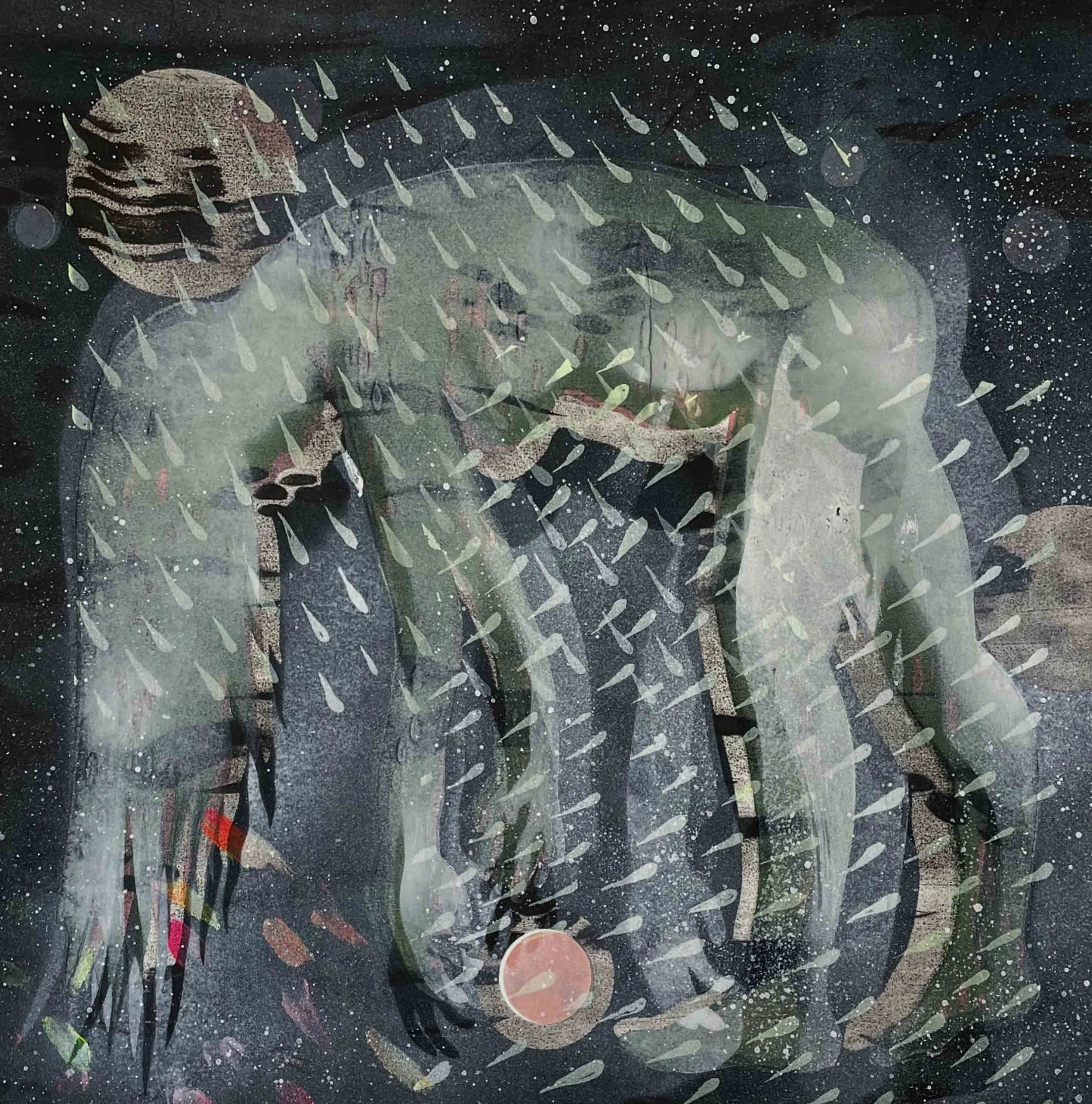
Katika Schultz, Tumbleweed Woman Edition Variee 11/16, Beyond the Matrix - Jenny Robinson Studio
Woodcut, Monoprint, Drypoint Etching, screenprint and spray paint, 50 x 50cm, 2025
About Katika Schultz
Katika Schultz is a Sydney-based figurative artist working primarily across printmaking and drawing. Her practice is material driven and maximalist, driven by an insatiable curiosity for layered print processes, material complexity, and detail. Personal motifs and weather systems recur throughout her work as metaphors for emotional and cultural experience.
Becoming a mother in 2023 profoundly shifted Katika’s artistic lens. Confronted by the inaccessibility and invisibility embedded in public space - vanishing footpaths, the absence of pram-accessible toilets, and systems not designed for caregiving. Her work now interrogates these structural omissions. Through large-scale prints and soft, labour-intensive processes, she centres the unseen, constant work of care.
Her current practice elevates the maternal body to public visibility, positioning motherhood as monumental, complex, and unapologetically present. By insisting on the visibility of care, ambivalence, pleasure, and exhaustion, her work opens space for new conversations around value, labour, and gendered time.
About Louise Whelan
Louise Whelan is an award-winning visual artist and oral historian whose multidisciplinary practice explores memory, environment, lived experience, and women’s knowledge systems. Her oral histories and photographs are held in national, state, and local collections, including the State Library of New South Wales, the National Library of Australia, and the UNESCO Australian Memory of the World Register.
Her recent project, Women in the Space Industry, documents women across Australia’s space sector through photography and oral history, forming the first national archive dedicated solely to women in space. The work has been exhibited at the International Astronautical Congress in Sydney, the Australian Embassy in Berlin, and Liverpool Library NSW, curated by Casual Powerhouse.
Louise is the founder of the Orbit Collective, currently a Powerhouse Museum Resident Artist. She is also Artist in Residence at Edie’s Place, a creative studio within a domestic-violence organisation, and works with Insight Exchange as a collaborating artist and Associate.
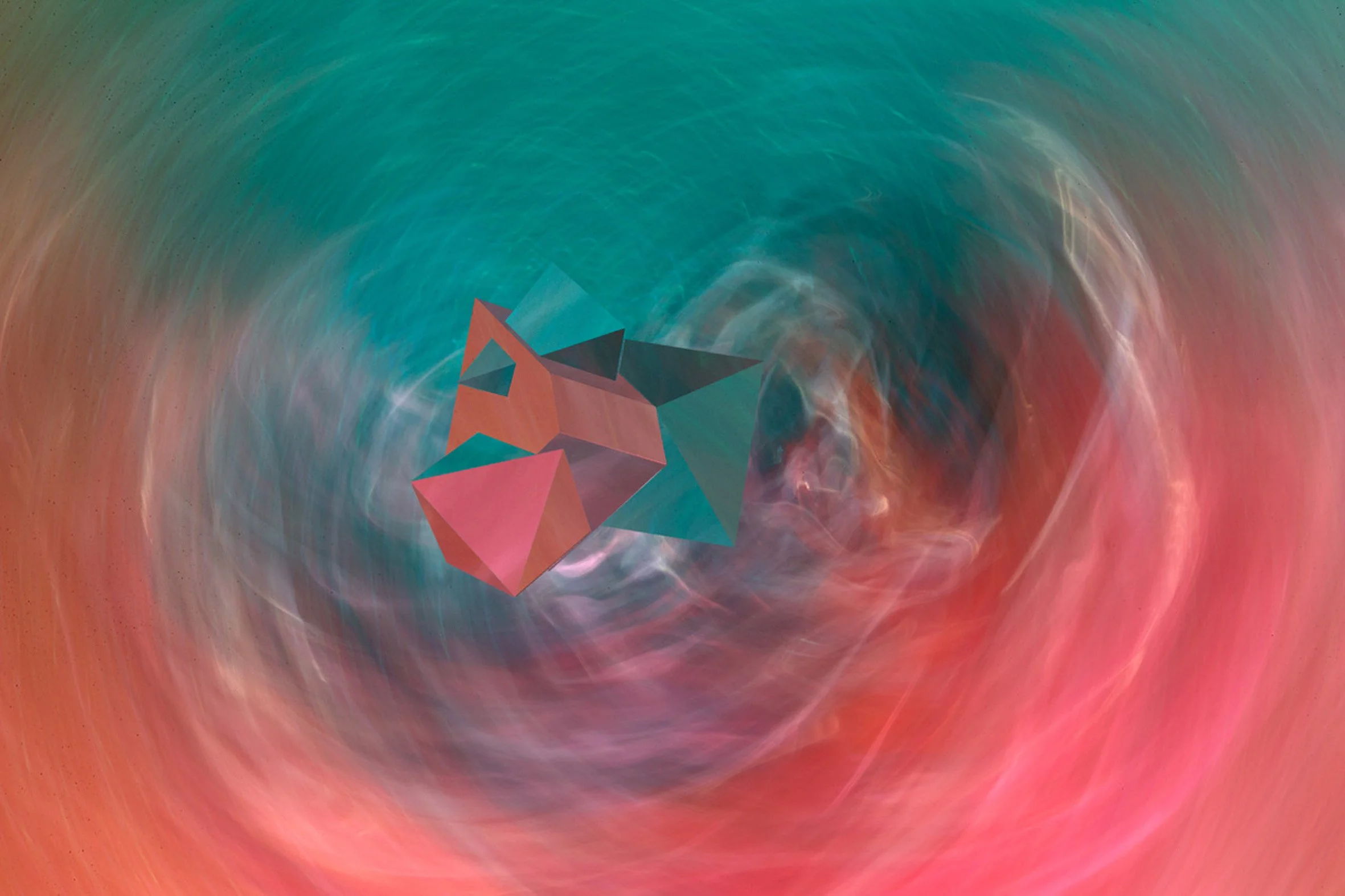
Louise Whelan, light drawings, 2025, inkjet on Canson paper.