
In the hiatus between leaving our location on Enmore Road in Newtown and moving into our new home in Marrickville, DRAW Space is delighted to present DRAWING NOW at Airspace, one of Sydney’s most exciting artist-run spaces.
DRAWING NOW features work by Lana Ardere, Megan Kennedy, William Potanin, Emma Regner and Kevin Wong.
This group exhibition is shaped by the board members of DRAW Space – an artist run initiative committed to experimental drawing – each of whom has invited one artist to participate. Participating board members are Monika Cvitanovic, Sarah Eddowes, Melinda Hunt, Fiona Verity and Belinda Yee.
Conceived as an informed glimpse into the diverse ways drawing is being approached today, the exhibition grows from conversations between curators and artists about how drawing is understood, practiced and reimagined in the present moment.
Join the artists and DRAW Space board members to celebrate at the opening event.
6-8pm Friday 4 September at Airspace, 10 Junction Street Marrickville.
The exhibition runs until 4pm Sunday 20 September.
AIRspace is open 5–8 pm Thursday and Friday and 10am–4pm Saturday and Sunday.
Emma Regner is represented by Eloise Cato Gallery.
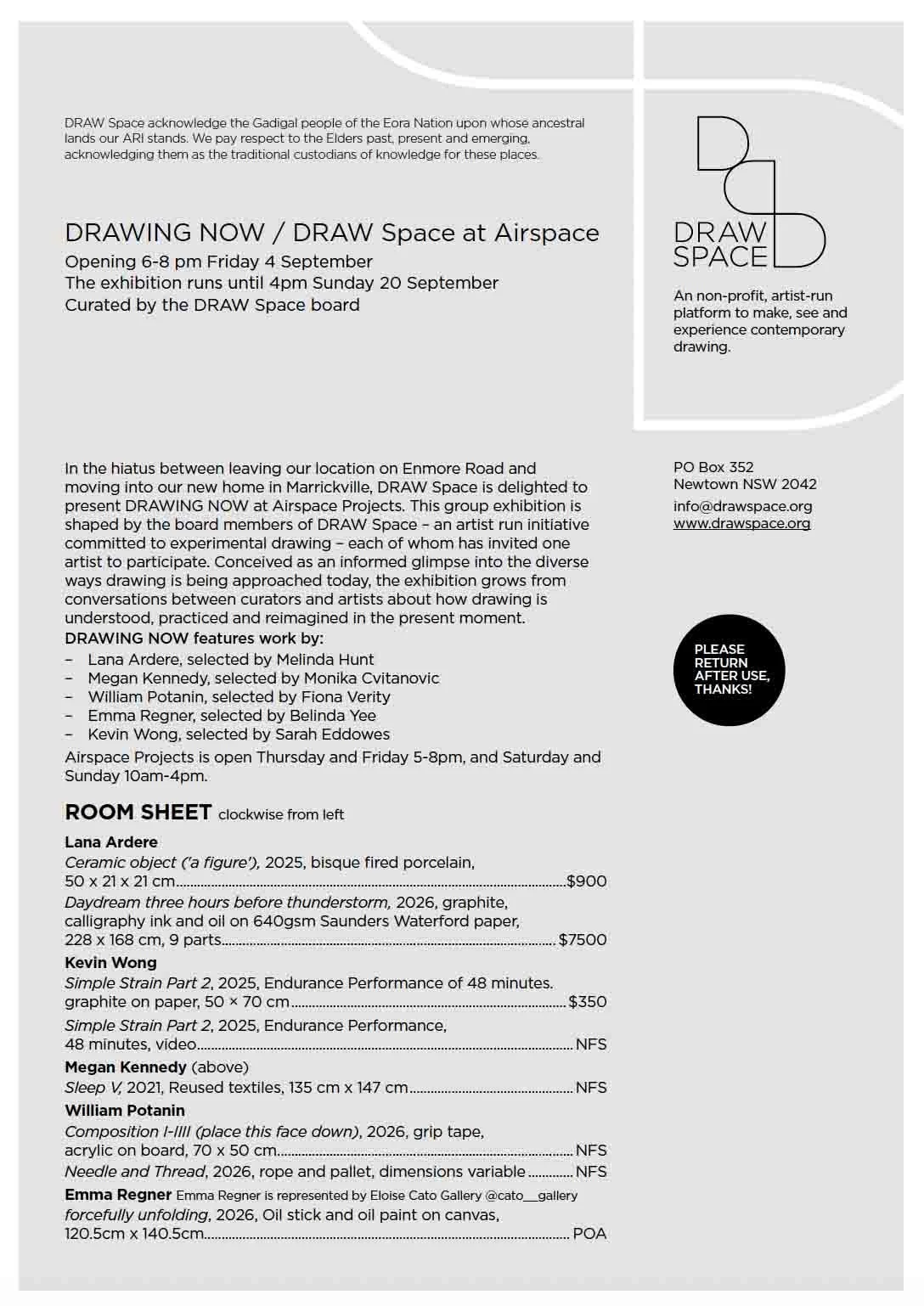
Exhibition Roomsheet
Click the image to download a pdf copy.
Curators’ Notes and Artists’ Statements
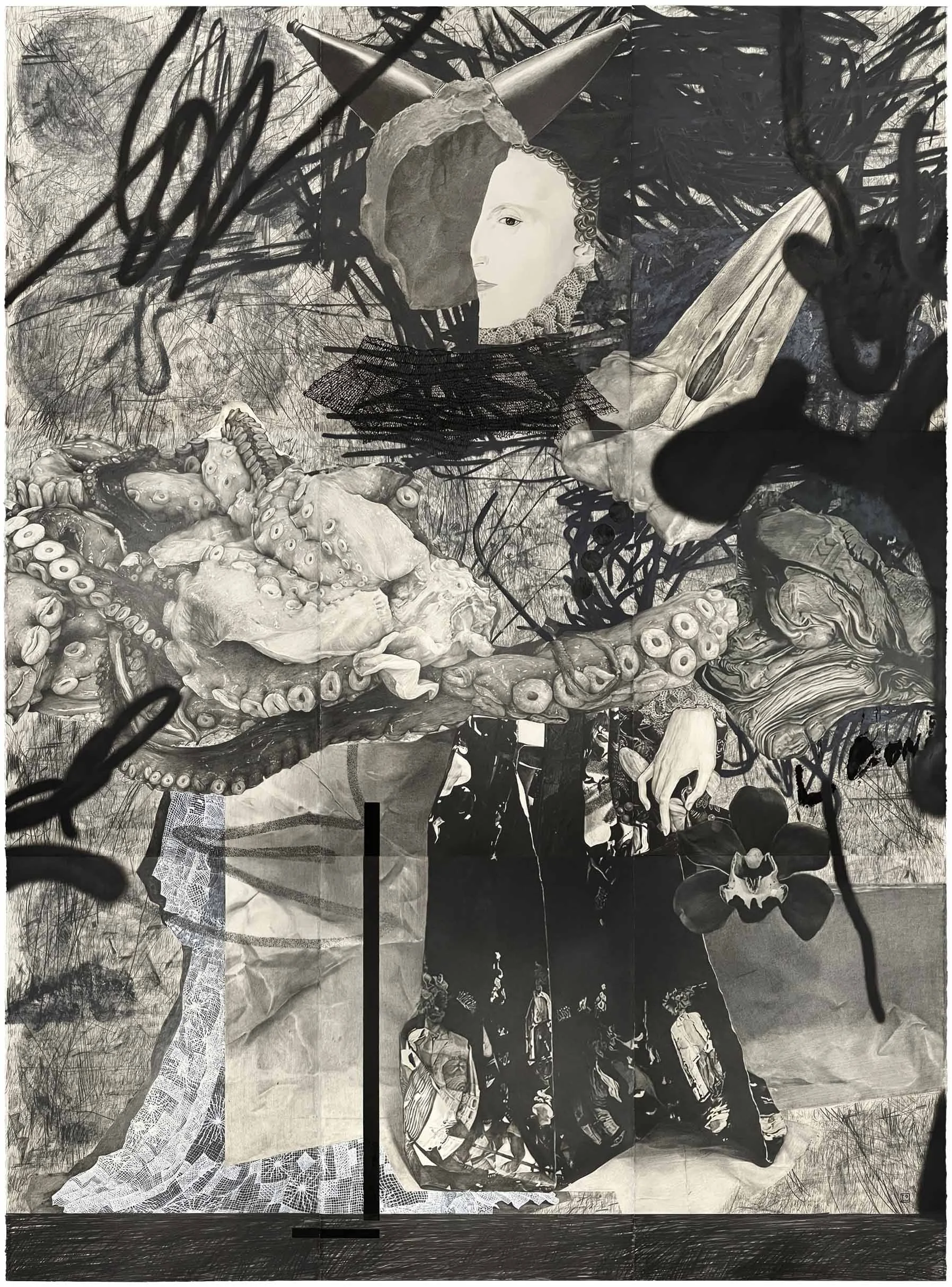
DRAW Space board member, Melinda Hunt, selected the work of Lana Ardere.
Melinda
If all art can be regarded as a self portrait of its maker, I believe that the intimacy and immediacy of drawing has a capacity, beyond other media, to expose the artists’ inner life, stripping back and revealing the psyche.
For Lana Ardere, the 24-hour news cycle is tipped into a simmering stew of memory, trauma and imagination in her meticulously detailed and surreal graphite drawings, the making of which serves therapeutic ends.
Lana
Drawing, at its basics, offers the most direct transfer of an idea and energy from an artist into an artwork. In every moment, the contact between pencil, surface and mind concentrates into a single point. As the movement continues, that point of friction between a pencil and a paper unfolds into a line or a tone. And when a drawing truly takes shape, all these dots, lines and tones create the illusion of a window into another world.
In my practice, the initial idea for a drawing emerges as a mixture of imagined and real events, collected images, memories of feelings, and associations. I choose the most strange elements for my compositions. This blend awakens an obscure shape in my mind, and through drawing, I aim to bring that figure into this world.
Many of my drawings are labour‑intensive, multi‑detailed and meticulous in execution. I approach them as both a mental and physical challenge, similar to a spiritual practice. The prolonged physicality of drawing allows me to reach a state where subconscious knowledge prevails — not by eliminating self‑reflection, doubt, or awkwardness of the creative process, but by working through them.
DRAW Space board member, Monika Cvitanovic, selected the work of Megan Kennedy.
Monika
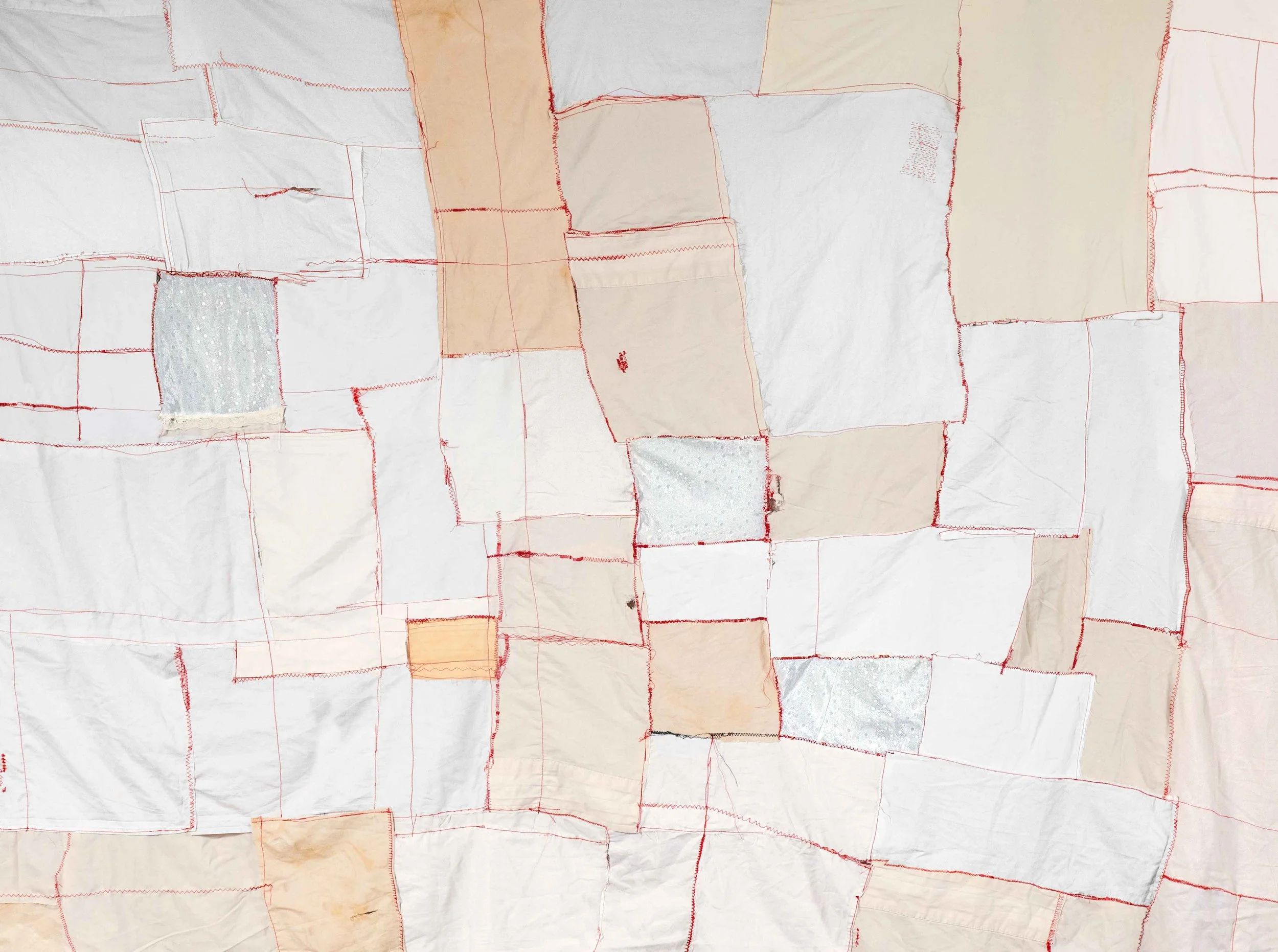
I work with thread as a drawing medium, a practice shaped by problem‑solving within textile processes that unsettle art‑historical expectations of pictorial space. Through accumulating free‑form cross stitches, each mark builds density, direction and form, operating like cross‑hatching while foregrounding the tactile integrity of fibre. Used to bind and secure cloth, in my work thread subverts the role of the pencil, becoming the structural agent of drawing itself.
I recognise this expanded agency of thread in Megan’s work, where labour‑intensive stitching generates abstract compositions with open‑ended potential, evoking patchwork while allowing line to move, assert itself and tell a story.
Megan
Hand, tool, surface, mark. Like a strand of drawn graphite, thread sets out as one linear stitch. Relying on tension, extension and tensile strength, accumulation rewards persistence and care. Although many drawing forms can claim the immediacy of mark-making, stitching and sewing slow creative production and impose unique parameters. Each threaded mark is a determined action of piercing, pulling and returning or advancing.
Like Monika’s approach, I apply thread as a drawing medium. Sewing is drawing with both the freedom and constraint of technology - the conditions of making become part of the mark. As both structure and feature, the stitch is labour spun visible.
The SLEEP series is an endeavour to give material form to my experience of chronically disordered sleep. Early in my textile career, I collaborated with my mum’s old Singer sewing machine. My frustrated lines - guided, fed, forced, pleaded and bargained for - contend as both seam and scar, a parallel to the testing experience of navigating somnipathy.
Binding and marking a ground of bedclothes and sleepwear, the drawn thread in SLEEP sustains a candid window of deconstruction, subversion and crude repair - offering a gentle capacity for problem solving.
DRAW Space board member, Fiona Verity, selected the work of William Pontanin.
Fiona
Drawing interests me because it is the closest we come to seeing how another person thinks. A mark can be hesitant, bold, awkward, controlled or searching; it tells us something about the person who made it. Drawing does not need to be polished, monumental or confined to pencil on paper. It can be stitched, scratched, printed, erased, walked or made in space. It can describe the world, but also test, question, and imagine it. In my practice, I explore an emotional response to place and how we attend to lived experiences. I believe drawing's strength lies in its directness, which keeps it open, human, and alive, whilst drawing us into the artist's thought process. Potanin's expanded drawing practice has caught my attention because his approach ignites my interest in drawing's endless possibilities.
William
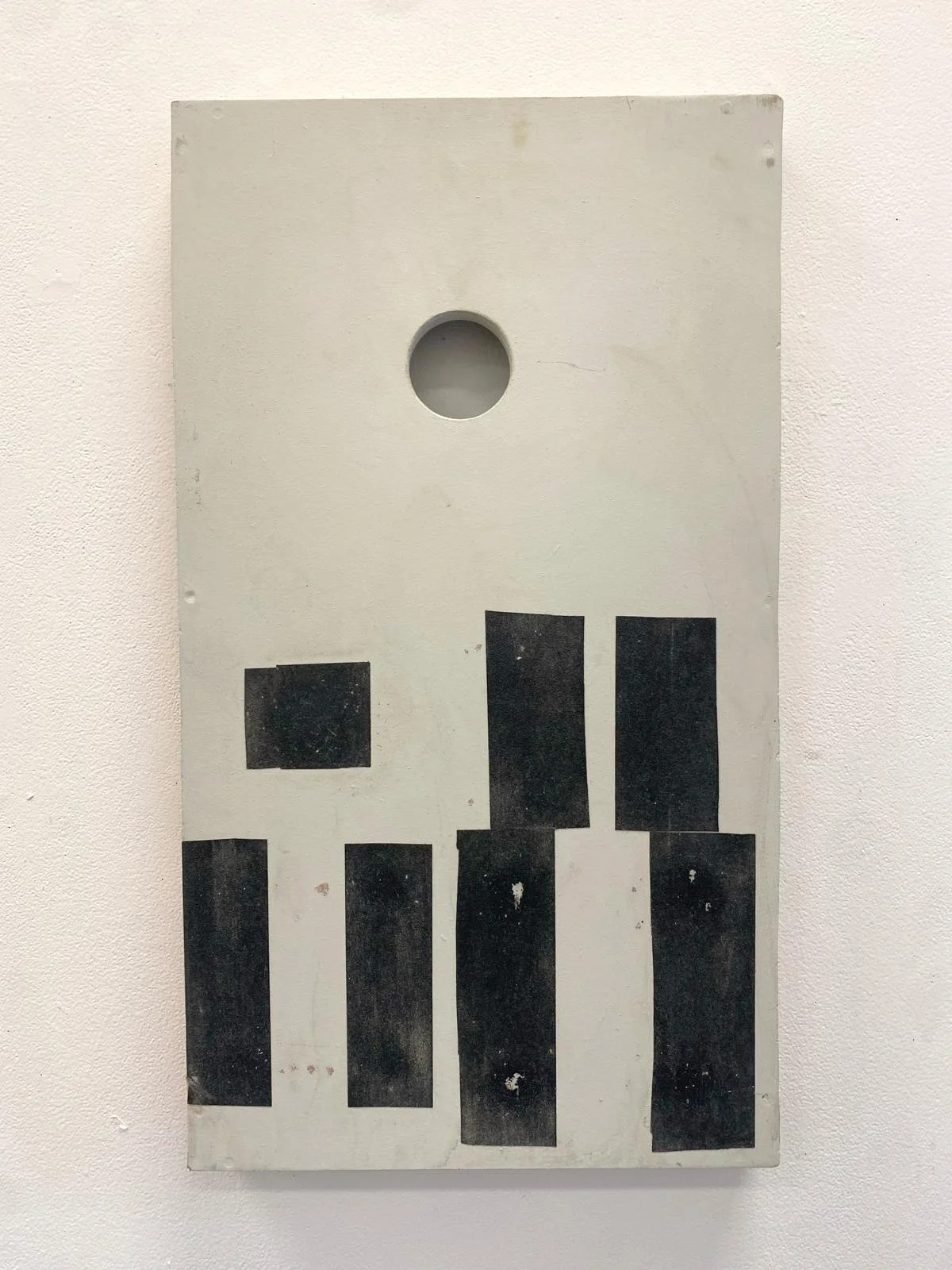
A drawing can be anything linear in nature; it marks when something starts and ends. A drawn line memorialises an action; it represents a temporal junction between nothing and completion, a suggestive journey of process, and the death of an action. Drawing, like many art forms, is performative in nature because of its relation to gesture. When somebody says a work of art is gestural, they often describe loose curved marks, but I think this definition is a disservice to the word. It flattens the relationships between body and material, material and matrix, matrix and site. A gestural drawing is a line that sits in relation to the mechanics and limitations of the human body, and the human body in relation to the space it occupies. A line, a gesture, is a product of a biomechanical system. A way of mapping both physical and subjective relationships.
I have been really interested in desire paths lately: nature trails worn down by foot traffic, often marking a more direct route between two points. A spatial line. A subtractive gesture that exposes the mineral substrate that holds vegetation.
Artworks function similarly: points that change or direct how one walks through and interacts with space; the movement of people in space, either captured through gesture or the barely perceptible atmospheric micro changes, are definable drawings.
DRAW Space board member, Belinda Yee, selected the work of Emma Regner.
Belinda
I think there are characteristics ascribed to drawing which, though present in other media, remain fundamental to its idea: directness, openness, brevity, line as its essential structure, and an efficiency of means. In addition, I would add that for me, drawing looks like ‘thought externalised,’ a process of thinking on the page.
I find exactly these things, a sense of directness, openness and brevity, in Emma’s work, where lines are used with economy to make sense through the act of making itself.
Emma
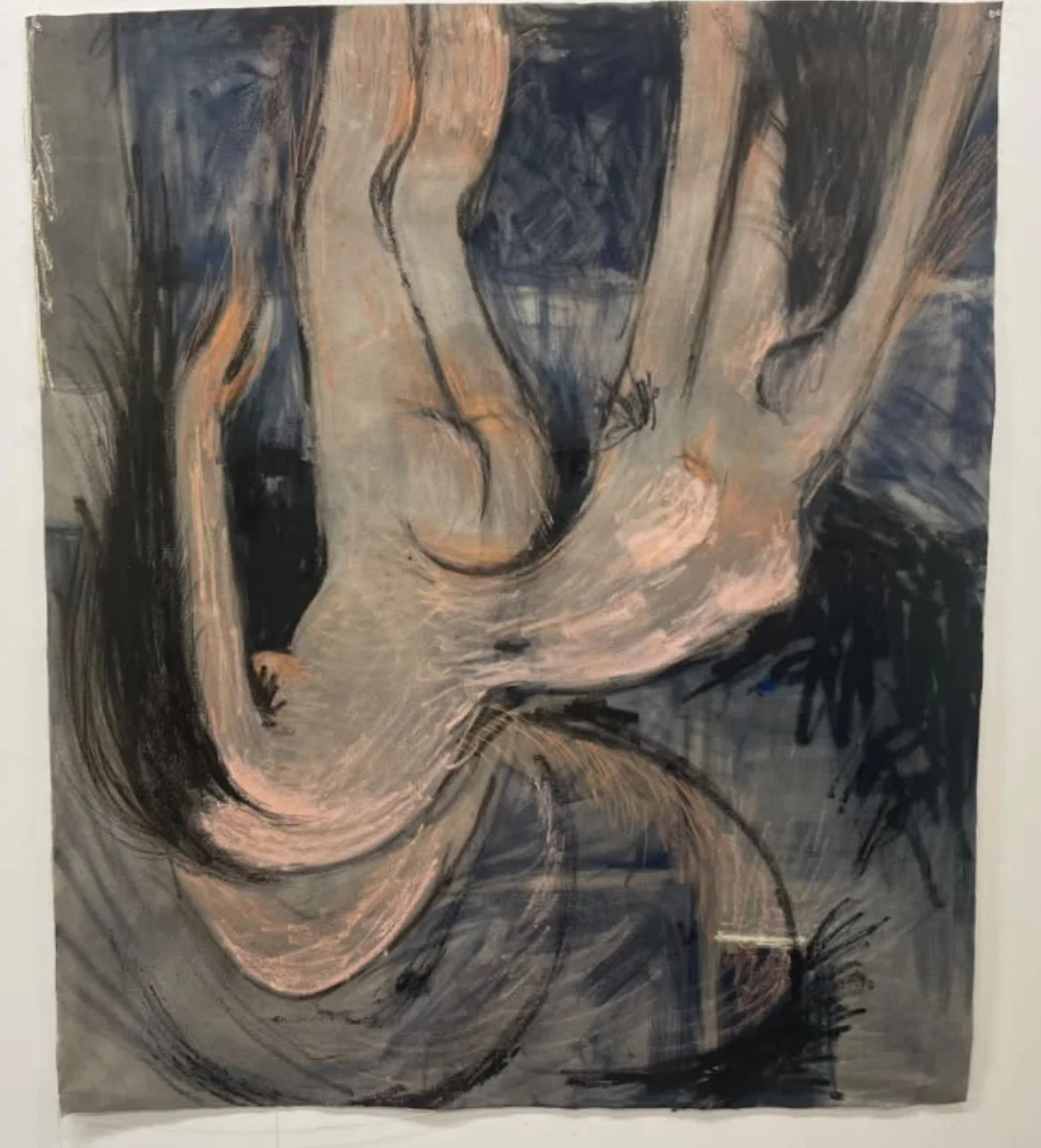
My artworks are autobiographical, prominently highlighting themes surrounding interpersonal relationships, issues of self worth, past traumas, sexuality and sex, and bodily autonomy. My figurative works display the body as an ever changing physical site that carries memories, past traumas, and expels emotion. I mediate lived experience through imagery and self-portraiture of my distorted body. My artwork forcefully unfolding is drawn from a specific encounter with an individual and the memory of how I felt.
I feel that my painting practice is fundamentally informed by the conventions of observational life drawing. I use references of my own figure, my physical features like my dark hair, light skin and female anatomy, to create imagined compositions and figures that are fused and contorted, pulling away from one another. Ensnared within each other, bursting to escape each other's conflicting hold. My drawing education comes from life drawing, where mark making is taught to be immediate and concise to effectively draw a representation of the person you are observing in a short amount of time. I’ve adopted this way of engaging with mark making that creates a rawness and allows for highly emotionally charged compositions. My material choice of oil stick on canvas allows me to draw onto canvas with this immediacy that is explosively emotive and honest.
DRAW Space board member, Sarah Eddowes, selected the work of Kevin Wong.
Sarah
I understand drawing as a channeling of a certain existing energy into linear form. This energy could be movement, the formation of thoughts or the relationship between objects, places or people. I’m interested in contemporary forms of drawing which explore unusual ways of achieving this.
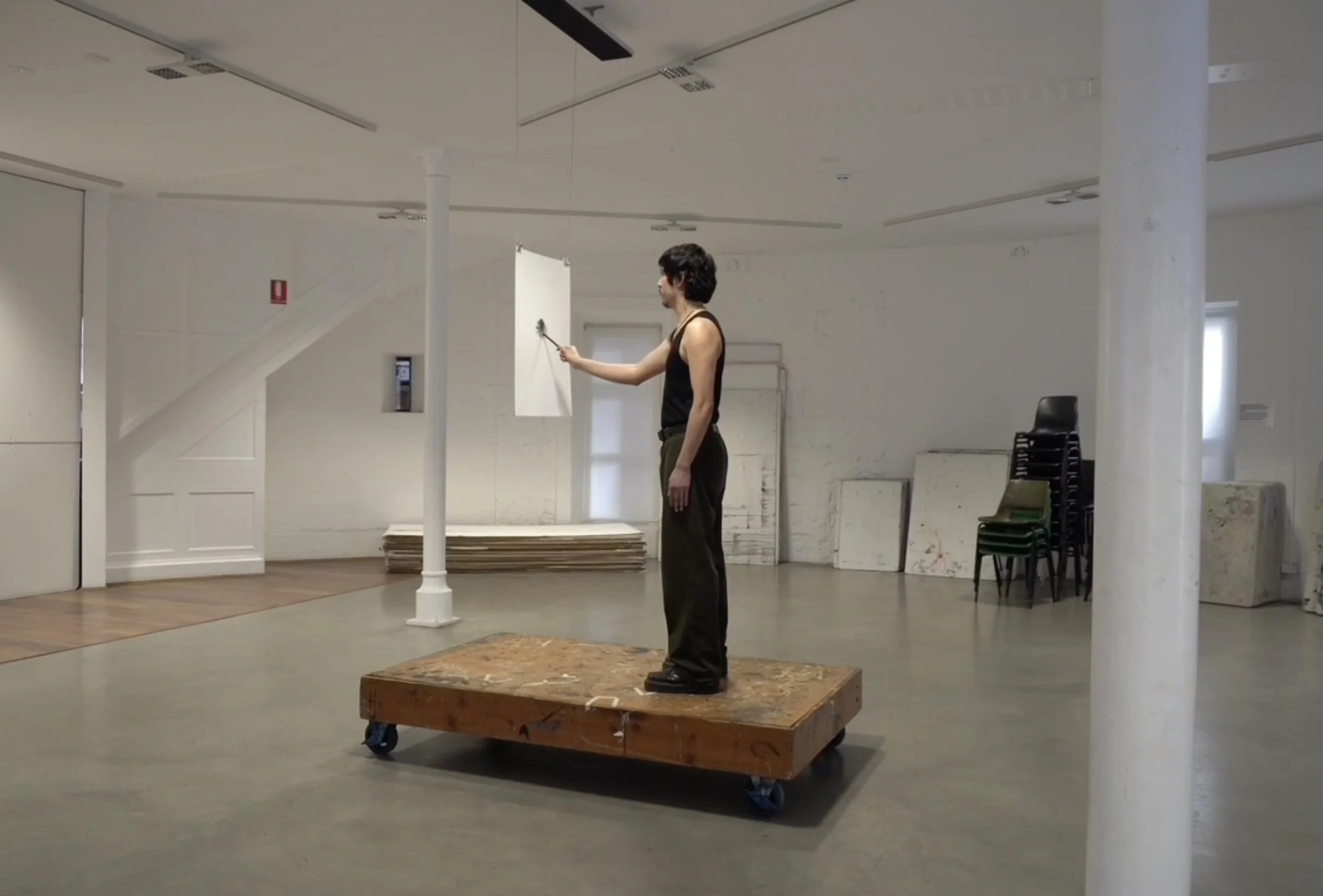
Kevin Wong uses his own body in a very direct way as an instrument for tracing out its own battle between stability and aberration.
Kevin
Drawing, to me, is the transformation of the intangible into observable remnants. The traces left by gesture, line and mark are expressive records of the imperceptible and unseen, whether that be a thought, an emotion, an observation or a sensation. To draw is to document and visualise a response to stimuli through action.
I am drawn to the substances of what remains and the memory consecrated within them. In my practise I collect marks and debris to preserve lived experience. Pain, endurance, fatigue and failure are archived within what is left behind.
In Simple Strain, time and the body are used to illustrate the toll of performing a simple action. Holding my arm outstretched towards paper for as long as I can, trembling dots of graphite time-stamp the battle between exhaustion and determination.
More recently, in my Submission/Conduction series, I use electro-stimulation to further investigate the body as a tool or mechanism for drawing. A generative array of sporadic marks induced by involuntary muscle contractions, this project brought insight into the structure of anatomy and the possibilities of drawing.